Megan Blake
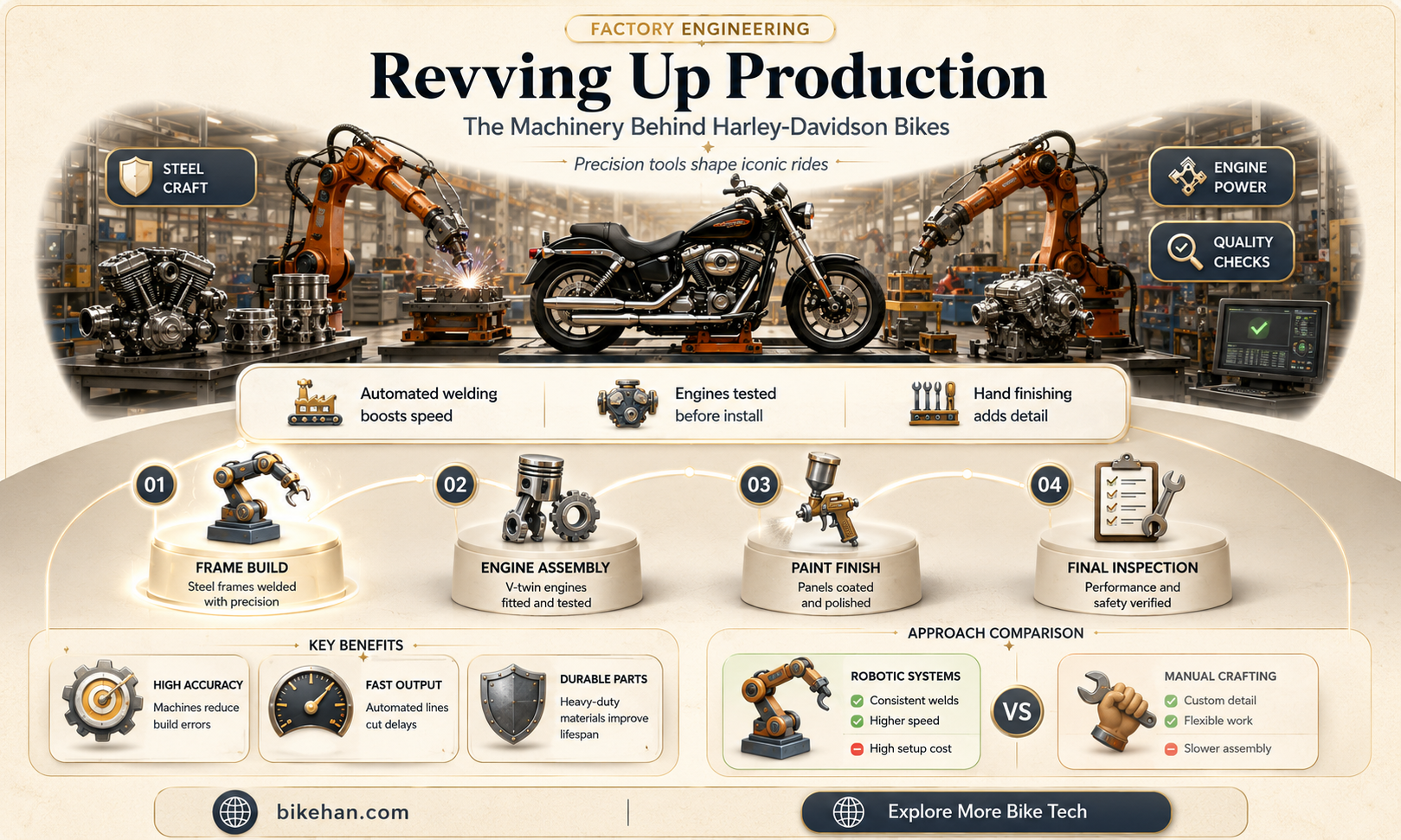
Harley-Davidson, an iconic American motorcycle manufacturer, utilizes a variety of specialized machines and equipment to produce their renowned bikes. The production process involves a blend of traditional craftsmanship and modern technology, ensuring that each motorcycle meets the high standards of quality and performance associated with the Harley-Davidson brand. From precision machining tools to advanced assembly lines, these machines play a crucial role in transforming raw materials into the powerful and stylish motorcycles that Harley-Davidson is famous for.
Explore related products


What You'll Learn
- Frame Construction: CNC machines and robotic arms for precision welding and assembly
- Engine Manufacturing: Machining centers and assembly lines for engine components and final assembly
- Painting and Finishing: Automated paint booths and conveyor systems for applying signature Harley-Davidson colors
- Quality Control: Inspection robots and vision systems to ensure parts meet strict quality standards
- Logistics and Assembly: Forklifts, conveyors, and automated guided vehicles for moving parts and final bike assembly

Frame Construction: CNC machines and robotic arms for precision welding and assembly
CNC machines and robotic arms play a crucial role in the precision welding and assembly of Harley-Davidson motorcycle frames. These advanced technologies ensure that each frame is constructed with exacting standards, which is essential for the durability and performance of the motorcycles.
CNC, or Computer Numerical Control, machines are used to automate the cutting, shaping, and drilling of frame components. These machines are programmed with precise specifications, allowing them to produce parts with high accuracy and consistency. This automation not only increases production efficiency but also reduces the likelihood of human error, resulting in higher-quality frames.
Robotic arms are employed in the welding process, where they can perform complex welds with greater precision than manual welding. These robots are equipped with sensors and cameras that allow them to adapt to slight variations in the parts, ensuring strong and clean welds every time. The use of robotic arms also improves safety in the manufacturing environment by minimizing the risk of burns and other injuries associated with manual welding.
In addition to welding, robotic arms are used in the assembly of the frames. They can handle and position heavy components with ease, reducing the physical strain on workers and increasing the speed of assembly. The robots are programmed to follow specific sequences and can be quickly reconfigured to accommodate different models or production changes.
The integration of CNC machines and robotic arms in Harley-Davidson's frame construction process exemplifies the company's commitment to innovation and quality. By leveraging these technologies, Harley-Davidson is able to produce motorcycles that meet the high expectations of their customers while maintaining a competitive edge in the market.
Choosing the Right Lube: A Guide to Bike Chain Lubricants
You may want to see also
Explore related products


Engine Manufacturing: Machining centers and assembly lines for engine components and final assembly
In the heart of Harley-Davidson's manufacturing process lies the engine assembly, a critical phase where precision and craftsmanship converge. Machining centers play a pivotal role in this stage, tasked with the intricate job of shaping and refining engine components to exact specifications. These advanced machines use computer numerical control (CNC) technology to execute complex cutting, drilling, and milling operations with unparalleled accuracy.
The journey of an engine component begins at the machining center, where raw materials are transformed into the finely tuned parts that will eventually power a Harley-Davidson motorcycle. The process involves a series of meticulous steps, starting with the loading of raw materials into the machine. The CNC system then guides the cutting tools to perform a sequence of operations, each one carefully programmed to achieve the desired dimensions and tolerances. This level of precision is crucial, as even the slightest deviation can impact the performance and reliability of the final product.
Once the components are machined, they move on to the assembly lines for the final assembly. This phase is a testament to the seamless integration of human skill and automated technology. Workers on the assembly line meticulously follow detailed instructions, ensuring that each component is correctly installed and secured. The use of automated systems, such as robotic arms and conveyor belts, streamlines the process, reducing the risk of human error and increasing efficiency.
The assembly line is organized into distinct stations, each responsible for a specific set of tasks. As the engine moves through these stations, additional components are added, and various systems are interconnected. Quality control checks are performed at regular intervals to ensure that the engine meets the stringent standards set by Harley-Davidson. This rigorous inspection process includes both visual assessments and functional tests, guaranteeing that the engine is not only aesthetically flawless but also performs optimally.
In conclusion, the engine manufacturing process for Harley-Davidson motorcycles is a sophisticated blend of advanced machinery and skilled human labor. Machining centers and assembly lines work in harmony to produce engines that are renowned for their power, durability, and craftsmanship. This intricate process is a key factor in maintaining the high quality and distinctive character that Harley-Davidson motorcycles are known for.
Choosing the Right Lube for Your Stationary Bike: A Guide
You may want to see also
Explore related products


Painting and Finishing: Automated paint booths and conveyor systems for applying signature Harley-Davidson colors
The painting and finishing process for Harley-Davidson motorcycles is a critical step in ensuring that each bike meets the company's high standards for quality and aesthetics. To achieve the signature Harley-Davidson colors, the company utilizes automated paint booths and conveyor systems. These advanced systems allow for precise application of paint, ensuring consistency and efficiency in the production process.
Automated paint booths are enclosed spaces designed to contain paint overspray and fumes, protecting the environment and workers from exposure to hazardous materials. Inside the booth, robotic arms equipped with spray guns apply paint to the motorcycle bodies with pinpoint accuracy. The conveyor system moves the bikes through the booth at a controlled pace, allowing for even coverage and proper drying time between coats.
One of the key benefits of using automated paint booths is the ability to achieve a high level of customization. Harley-Davidson offers a wide range of color options for their motorcycles, and the automated system can be programmed to apply different colors and patterns to each bike. This flexibility allows the company to cater to the unique preferences of their customers while maintaining a high level of production efficiency.
In addition to the automated paint booths, Harley-Davidson also employs a team of skilled painters who perform manual touch-ups and detailing on each motorcycle. This combination of automated and manual processes ensures that every bike receives the attention to detail that Harley-Davidson is known for.
Overall, the painting and finishing process is a crucial component of Harley-Davidson's manufacturing operations. By utilizing advanced technology and skilled craftsmanship, the company is able to produce motorcycles that are not only visually stunning but also built to last.
Safe Cycling After Tooth Extraction: Tips and Precautions
You may want to see also
Explore related products


Quality Control: Inspection robots and vision systems to ensure parts meet strict quality standards
In the intricate process of manufacturing Harley-Davidson motorcycles, quality control stands as a paramount concern. To ensure that each part meets the stringent standards set by the company, advanced inspection robots and vision systems are employed. These technologies play a crucial role in maintaining the high quality and reliability that Harley-Davidson is known for.
Inspection robots are equipped with high-resolution cameras and sensors that allow them to meticulously examine each component for defects or inconsistencies. These robots can be programmed to perform a variety of tasks, from simple visual inspections to more complex operations such as measuring dimensions and checking for surface imperfections. By automating these processes, Harley-Davidson can achieve a level of precision and consistency that would be difficult to attain through manual inspection alone.
Vision systems, on the other hand, use computer vision technology to analyze images captured by cameras. These systems can identify and classify objects, detect anomalies, and measure distances with remarkable accuracy. In the context of Harley-Davidson's manufacturing process, vision systems are used to inspect parts such as engine components, wheels, and frames. By quickly and accurately identifying any issues, these systems help to streamline the quality control process and reduce the time it takes to bring a motorcycle from the production line to the showroom.
One of the key benefits of using inspection robots and vision systems is the ability to detect defects early in the manufacturing process. This not only saves time and resources but also helps to maintain the high standards of quality that Harley-Davidson customers expect. By identifying and addressing issues before they become more significant problems, the company can ensure that each motorcycle that leaves the factory is of the utmost quality.
In conclusion, the use of inspection robots and vision systems in Harley-Davidson's manufacturing process is a testament to the company's commitment to quality and innovation. These advanced technologies allow for precise and efficient quality control, ensuring that each motorcycle meets the strict standards that have made Harley-Davidson a legendary brand in the world of motorcycling.
Gearing Up: The Impact of Tooth Count on Bike Performance
You may want to see also
Explore related products

$14.99 $30.95


Logistics and Assembly: Forklifts, conveyors, and automated guided vehicles for moving parts and final bike assembly
Forklifts play a crucial role in the logistics and assembly of Harley-Davidson motorcycles. These powerful machines are used to transport heavy parts and components across the factory floor, ensuring that everything from engines to fenders is moved efficiently and safely. Forklifts are particularly useful for lifting and maneuvering large, bulky items that would be difficult or impossible for workers to handle manually.
Conveyors are another essential component of the assembly process. These mechanized systems are designed to move parts and subassemblies from one workstation to another, streamlining the production workflow and reducing the need for manual labor. Conveyors can be configured in a variety of ways to accommodate different production needs, and they can be equipped with sensors and other automated systems to ensure that parts are moved and assembled with precision and accuracy.
Automated guided vehicles (AGVs) are also used in the production of Harley-Davidson motorcycles. These robotic systems are programmed to navigate the factory floor and transport parts and materials to specific locations. AGVs can operate independently or as part of a coordinated system, and they can be equipped with a range of sensors and communication devices to ensure that they interact safely and efficiently with other machines and workers.
The use of these machines in the logistics and assembly of Harley-Davidson motorcycles helps to improve efficiency, reduce costs, and enhance the overall quality of the final product. By automating many of the tasks involved in moving parts and assembling bikes, these machines allow workers to focus on more complex and specialized tasks, such as quality control and customization. This combination of human skill and machine automation helps to ensure that every Harley-Davidson motorcycle is built to the highest standards of quality and craftsmanship.
Smooth Shifting: The Ultimate Guide to Bike Cable Lubricants
You may want to see also
Frequently asked questions
Harley-Davidson utilizes a variety of machines in their production process, including CNC (Computer Numerical Control) machines for precision parts manufacturing, robotic assembly lines for efficient and consistent assembly, and automated welding machines for joining metal components.
Harley-Davidson employs rigorous quality control measures throughout their production process. This includes the use of advanced inspection equipment, such as coordinate measuring machines (CMMs) and vision systems, to verify part dimensions and assembly accuracy. Additionally, each bike undergoes extensive testing, both on the assembly line and in real-world conditions, to ensure it meets the company's high standards for performance and reliability.
Automation plays a significant role in the production of Harley-Davidson bikes, enhancing efficiency, consistency, and safety. Automated systems are used for tasks such as parts handling, welding, painting, and assembly. These systems not only speed up production but also reduce the risk of human error and improve overall product quality.
Yes, despite the extensive use of automation, there are still manual processes involved in the production of Harley-Davidson bikes. Skilled craftsmen are responsible for tasks such as final assembly, quality inspection, and custom finishes. These manual processes ensure that each bike receives the attention to detail and craftsmanship that Harley-Davidson is known for.