Matthew Brooks
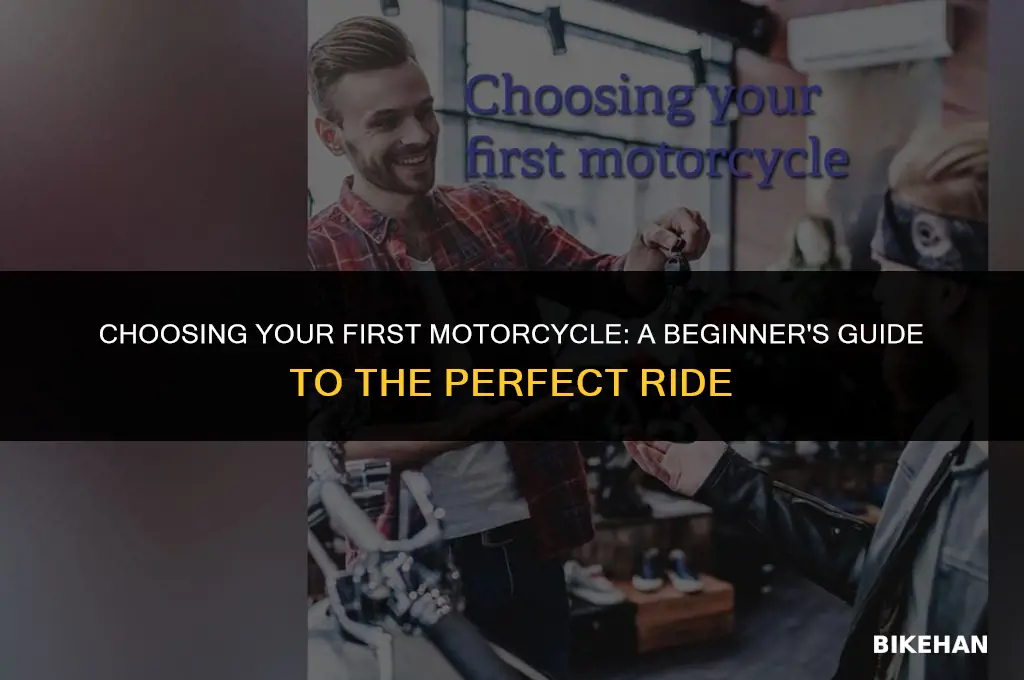
Choosing your first motorcycle is an exciting decision that requires careful consideration. As a beginner, it's essential to prioritize safety, comfort, and ease of handling. Look for bikes with a lower seat height and a more upright riding position to ensure better control and visibility. Additionally, consider motorcycles with a smaller engine displacement, typically around 250cc to 500cc, as they offer a good balance of power and manageability for new riders. Reliability and maintenance costs are also crucial factors to keep in mind. Research different models, read reviews, and consult with experienced riders to find the perfect motorcycle that suits your needs and preferences.
Explore related products


What You'll Learn
- Budget-friendly options: Affordable motorcycles for beginners, balancing cost and quality
- Engine size: Choosing the right engine displacement for a new rider's skill level
- Comfort and ergonomics: Motorcycles with comfortable seating and easy handling for long rides
- Safety features: Bikes equipped with advanced safety technology to protect new riders
- Maintenance and reliability: Motorcycles known for their durability and ease of maintenance

Budget-friendly options: Affordable motorcycles for beginners, balancing cost and quality
For new riders on a budget, finding an affordable motorcycle that doesn't compromise on quality can be a challenge. However, there are several options available that offer a good balance between cost and performance. One popular choice is the Honda CB500F, which provides a reliable and efficient ride for around $6,000. Another option is the Yamaha MT-07, known for its powerful engine and comfortable handling, priced at approximately $7,000.
When considering budget-friendly motorcycles, it's essential to think about the long-term costs as well. While the initial purchase price is important, factors such as fuel efficiency, maintenance costs, and insurance rates can significantly impact the overall affordability of a motorcycle. For example, a bike with a smaller engine may have lower fuel consumption and insurance costs, but it might also require more frequent maintenance.
In addition to the Honda CB500F and Yamaha MT-07, other affordable options for beginners include the Kawasaki Ninja 400 ($6,500), the Suzuki GSX-R400 ($6,000), and the KTM RC 390 ($6,500). These motorcycles offer a good mix of performance, reliability, and affordability, making them suitable choices for new riders looking to get started without breaking the bank.
When shopping for a budget-friendly motorcycle, it's crucial to prioritize safety features and comfort. Look for bikes with ABS brakes, traction control, and a comfortable riding position. Test rides can help you determine which motorcycle feels best for you and your riding style.
Ultimately, the key to finding an affordable motorcycle for beginners is to do your research and consider all the factors that contribute to the overall cost of ownership. By balancing cost and quality, you can find a motorcycle that meets your needs and budget, setting you up for a safe and enjoyable riding experience.
Unlocking Elite Bikes in Riders Republic: A Comprehensive Guide
You may want to see also
Explore related products


Engine size: Choosing the right engine displacement for a new rider's skill level
Choosing the right engine displacement for a new rider is crucial as it directly impacts the riding experience, safety, and overall enjoyment. A common misconception is that bigger engines are always better, but this is not necessarily true, especially for beginners. In fact, starting with a smaller engine can be more beneficial in the long run.
For new riders, it's essential to consider the power-to-weight ratio of the motorcycle. A bike with too much power can be overwhelming and difficult to control, leading to potential accidents. On the other hand, a bike with too little power may struggle to keep up with traffic or provide the necessary acceleration for safe merging. The ideal engine size for a beginner typically ranges between 250cc to 500cc, as these bikes offer a good balance of power and maneuverability.
When selecting an engine size, it's also important to consider the rider's physical size and strength. A larger rider may find a smaller bike less comfortable and more challenging to handle, while a smaller rider may struggle with a larger, heavier bike. Additionally, the type of riding the new rider plans to do should be taken into account. For example, if the rider intends to primarily ride on highways, a slightly larger engine may be more suitable, whereas for city commuting, a smaller engine may be more practical.
Another factor to consider is the cost associated with different engine sizes. Generally, larger engines are more expensive to purchase, insure, and maintain. For a new rider, it's often more economical to start with a smaller engine and gradually move up as their skills and confidence improve.
In conclusion, choosing the right engine size for a new rider involves careful consideration of various factors, including power-to-weight ratio, rider's physical size, intended use, and cost. By selecting an appropriate engine displacement, new riders can ensure a safer, more enjoyable, and cost-effective riding experience.
Choosing the Perfect Commute Bike: A Comprehensive Guide
You may want to see also
Explore related products


Comfort and ergonomics: Motorcycles with comfortable seating and easy handling for long rides
For long-distance riders, comfort and ergonomics are paramount when selecting a motorcycle. The seating position, handlebar reach, and overall bike geometry can significantly impact rider fatigue and enjoyment over extended periods. Motorcycles designed with comfort in mind often feature more relaxed riding positions, wider and more cushioned seats, and handlebars that reduce strain on the wrists and shoulders.
One key aspect to consider is the seat height and shape. A lower seat height can provide better control and stability, especially for new riders, while a contoured seat design can offer improved support and reduce pressure points. Additionally, the placement and angle of the footpegs can influence rider comfort, as they should allow for a natural leg position without causing undue strain on the knees or ankles.
Ergonomics also play a crucial role in reducing rider fatigue. Handlebars that are too low or too high can lead to discomfort in the wrists, arms, and shoulders. A bike with adjustable handlebars or risers can help riders find the optimal position for their body type and riding style. Similarly, the positioning of the controls, such as the clutch, brake, and throttle, should be within easy reach to minimize strain and allow for smooth operation.
When evaluating motorcycles for comfort and ergonomics, it's essential to consider the rider's individual needs and preferences. Factors such as body size, riding experience, and intended use (e.g., touring, commuting, or leisure riding) can all influence the ideal motorcycle design. Test riding different models and consulting with experienced riders or motorcycle dealers can provide valuable insights into finding the most comfortable and ergonomic bike for long rides.
In summary, prioritizing comfort and ergonomics when selecting a motorcycle for long rides can significantly enhance the overall riding experience. By considering factors such as seat design, handlebar placement, and control positioning, riders can find a bike that minimizes fatigue and maximizes enjoyment, making long-distance journeys more comfortable and enjoyable.
Choosing the Perfect Bike Shorts Length: A Comprehensive Guide
You may want to see also
Explore related products


Safety features: Bikes equipped with advanced safety technology to protect new riders
For new riders, safety is paramount when choosing a first motorcycle. Bikes equipped with advanced safety technology can significantly reduce the risk of accidents and injuries. One such feature is Anti-lock Braking System (ABS), which prevents the wheels from locking up during sudden braking, allowing the rider to maintain control. Another crucial safety feature is Traction Control, which helps prevent the rear wheel from slipping by reducing engine power or applying the rear brake when it detects loss of traction.
In addition to ABS and Traction Control, some motorcycles come with Electronic Stability Control (ESC), which assists in maintaining stability during sudden maneuvers or when riding on uneven surfaces. Cornering ABS is another advanced feature that adjusts braking pressure during turns to prevent the wheels from locking up and causing a skid. These technologies work together to provide a safer riding experience, especially for those who are new to motorcycling and may not have the skills or experience to handle challenging situations.
When considering a first motorcycle, it's essential to look for models that incorporate these safety features. While they may increase the cost of the bike, the investment in safety is well worth it. Additionally, many insurance companies offer discounts for motorcycles equipped with advanced safety technology, which can help offset the initial cost.
Some popular motorcycle models that come with advanced safety features include the Honda CBR500R, which offers ABS and Traction Control, and the BMW G 310 R, which features ABS and ASC (Automatic Stability Control). The Yamaha MT-07 also comes with ABS and Traction Control, making it a good option for new riders looking for a versatile and safe bike.
Ultimately, the best motorcycle for a new rider is one that not only fits their budget and riding style but also prioritizes safety. By choosing a bike equipped with advanced safety technology, new riders can enjoy their motorcycling experience with greater confidence and reduced risk.
Choosing the Perfect Bike for Burning Man: A Comprehensive Guide
You may want to see also
Explore related products




Maintenance and reliability: Motorcycles known for their durability and ease of maintenance
When considering your first motorcycle, it's crucial to think about the long-term commitment you're making. Maintenance and reliability are key factors that can significantly impact your ownership experience. Some motorcycles are renowned for their durability and ease of upkeep, making them ideal choices for new riders.
One such motorcycle is the Honda CB500F. This naked bike is not only stylish but also incredibly reliable. Its simple design and robust engine make it easy to maintain, even for those new to motorcycle mechanics. The CB500F's air-cooled engine is less complex than liquid-cooled alternatives, reducing the risk of leaks and the need for frequent coolant changes. Additionally, its chain drive is straightforward to clean and lubricate, ensuring smooth operation with minimal fuss.
Another excellent option is the Suzuki DR-Z400S. This dual-sport motorcycle is built to handle both on-road and off-road conditions, making it a versatile choice for new riders. The DR-Z400S features a single-cylinder engine, which is inherently simpler and more reliable than multi-cylinder engines. Its upright riding position and comfortable seat make it easy to maneuver, while its lightweight frame simplifies maintenance tasks. The DR-Z400S also boasts a reputation for excellent fuel efficiency, reducing your overall costs of ownership.
If you're looking for a cruiser, the Harley-Davidson Sportster Iron 883 is a great choice. This iconic motorcycle is known for its rugged reliability and ease of maintenance. The Iron 883's V-twin engine is air-cooled and has a simple design, making it less prone to mechanical issues. Its belt drive eliminates the need for chain maintenance, and the bike's overall simplicity means there are fewer components that can go wrong. Additionally, the Sportster Iron 883 has a large community of enthusiasts and plenty of aftermarket support, making it easy to find parts and advice when needed.
In conclusion, when choosing your first motorcycle, it's essential to prioritize maintenance and reliability. The Honda CB500F, Suzuki DR-Z400S, and Harley-Davidson Sportster Iron 883 are all excellent options that offer durability and ease of upkeep. By selecting a motorcycle with a reputation for reliability, you can ensure a more enjoyable and hassle-free ownership experience.
Choosing the Perfect Ride: A Guide to Selecting Your Ideal Bicycle
You may want to see also