Lauren Kennedy
Proper tire pressure is crucial for both the performance and safety of a bicycle. The recommended psi (pounds per square inch) for bike tires varies depending on several factors, including the type of bike, the rider's weight, and the riding conditions. For road bikes, a higher pressure is typically recommended to reduce rolling resistance and improve speed, while mountain bikes may require lower pressures for better traction on rough terrain. Hybrid and commuter bikes usually fall somewhere in between. It's important to consult the manufacturer's recommendations or a local bike shop to determine the optimal tire pressure for your specific bike and riding style. Maintaining the correct tire pressure can help prevent flats, improve handling, and extend the life of your tires.
Explore related products


What You'll Learn
- Understanding Tire Pressure: Defining PSI and its importance for bike tire performance and safety
- Recommended PSI Ranges: General guidelines for road, mountain, and hybrid bike tire pressures
- Factors Influencing PSI: How rider weight, riding style, and terrain affect optimal tire pressure
- Checking and Adjusting PSI: Methods for accurately measuring and adjusting bike tire pressure
- PSI and Tire Maintenance: Tips on how proper inflation contributes to tire longevity and performance

Understanding Tire Pressure: Defining PSI and its importance for bike tire performance and safety
Pounds per square inch (PSI) is a unit of pressure commonly used to measure the inflation level of bicycle tires. Understanding PSI is crucial for maintaining optimal tire performance and ensuring rider safety. Proper tire inflation affects various aspects of cycling, including handling, comfort, and efficiency.
The importance of PSI for bike tire performance cannot be overstated. Underinflated tires can lead to increased rolling resistance, making it harder to pedal and reducing overall speed. They also tend to absorb more road vibrations, which can result in a less comfortable ride. On the other hand, overinflated tires can cause the bike to feel harsh and unresponsive, as they are less able to absorb shocks from the road. This can lead to a decrease in traction and an increased risk of punctures.
In terms of safety, maintaining the correct PSI is essential for preventing accidents. Underinflated tires are more prone to pinch punctures, where the tire is pinched between the rim and an obstacle, causing a sudden loss of air. Overinflated tires, while less likely to puncture, can be more susceptible to blowouts, which can occur when the tire is subjected to a sudden impact or excessive force.
To determine the proper PSI for your bike tires, it's important to consider factors such as your weight, the type of riding you'll be doing, and the road conditions. Most bike tires have a recommended inflation range printed on the sidewall, which can serve as a starting point. However, it may be necessary to experiment with different pressures to find the optimal setting for your specific needs.
Regularly checking and adjusting tire pressure is a simple yet effective way to ensure your bike is performing at its best. Investing in a good quality tire pump and pressure gauge can make this process easier and more accurate. By understanding the role of PSI in bike tire performance and safety, you can take steps to improve your riding experience and reduce the risk of accidents.
Exploring the Tattico Bike Tire App: A Cyclist's Guide
You may want to see also
Explore related products


Recommended PSI Ranges: General guidelines for road, mountain, and hybrid bike tire pressures
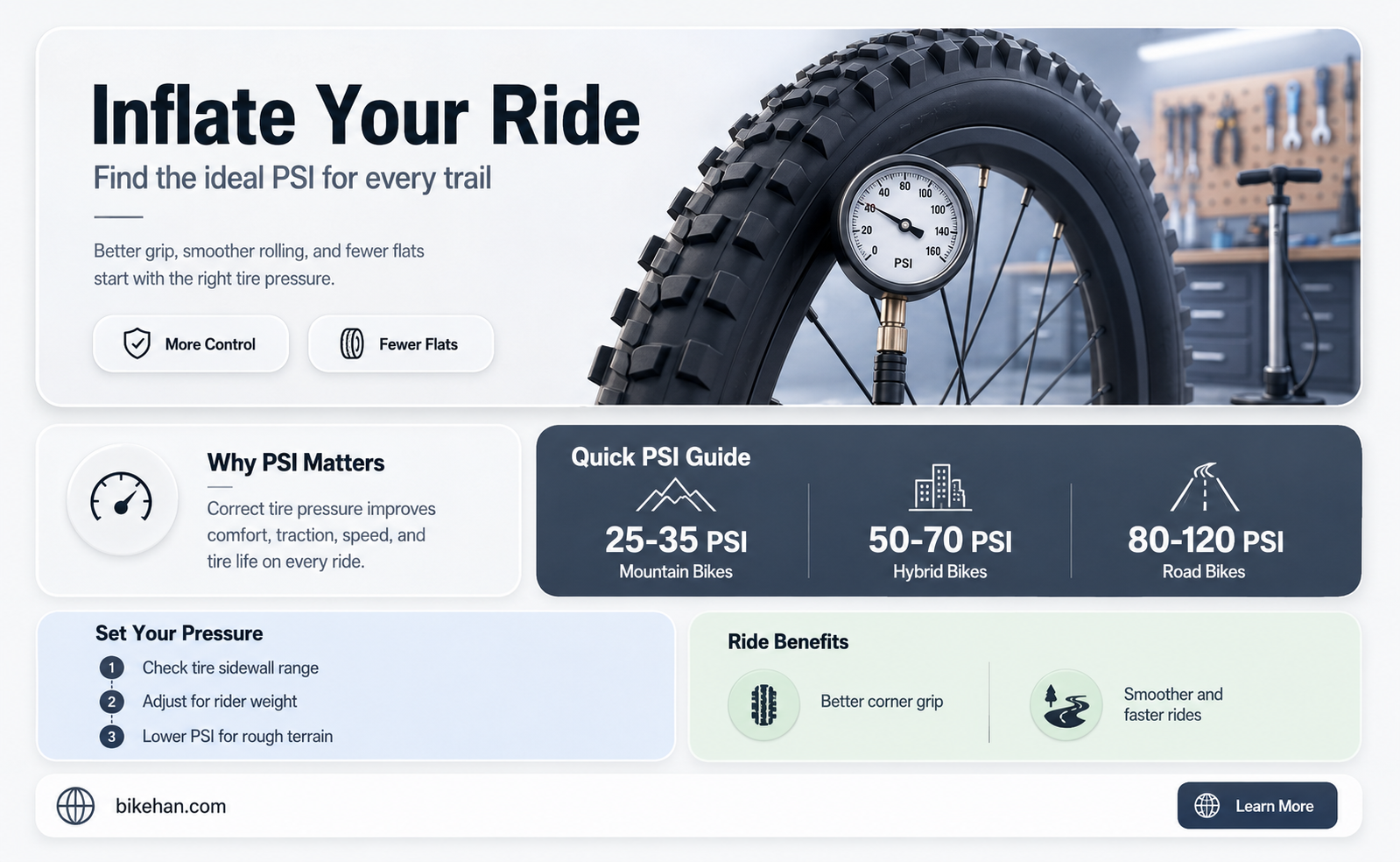
Understanding the proper PSI (pounds per square inch) for bike tires is crucial for optimal performance, safety, and comfort. The recommended PSI ranges vary depending on the type of bike and riding conditions. For road bikes, which are designed for speed and efficiency on paved surfaces, the typical PSI range is between 80 to 120. This higher pressure helps reduce rolling resistance and improves aerodynamics. However, it's essential to adjust this range based on factors such as rider weight, road conditions, and personal preference.
Mountain bikes, built for off-road adventures and rough terrain, require a lower PSI to absorb shocks and maintain traction. The recommended range for mountain bike tires is usually between 30 to 50 PSI. This lower pressure allows the tires to conform better to uneven surfaces, providing a smoother ride and better control. As with road bikes, adjustments should be made considering the rider's weight and the specific trail conditions.
Hybrid bikes, which combine elements of road and mountain bikes for versatile use, typically fall in the middle when it comes to PSI ranges. A general guideline for hybrid bike tires is 50 to 70 PSI. This range offers a balance between the high pressure needed for efficient road riding and the lower pressure required for off-road capability. Again, fine-tuning the PSI based on individual factors is key to achieving the best performance.
It's important to note that these are general guidelines, and the optimal PSI for your bike tires may vary. Factors such as tire size, brand, and material can also influence the recommended pressure. Always refer to the manufacturer's recommendations and experiment with different pressures to find the perfect balance for your specific bike and riding style. Regularly checking and adjusting tire pressure is a simple yet effective way to enhance your cycling experience and ensure your safety on the road or trail.
Inflating Knowledge: Understanding the Pressure Within Your Bike Tires
You may want to see also
Explore related products


Factors Influencing PSI: How rider weight, riding style, and terrain affect optimal tire pressure
Analyzing the factors that influence the proper PSI for bike tires reveals a complex interplay between rider weight, riding style, and terrain. Rider weight is a critical factor because it directly affects the amount of pressure needed to support the rider and maintain optimal tire performance. Heavier riders will generally require higher tire pressures to prevent tire deformation and ensure adequate support, while lighter riders can use lower pressures for a smoother ride and better traction.
Riding style also plays a significant role in determining the ideal PSI. Aggressive riders who prioritize speed and handling may prefer higher tire pressures to reduce rolling resistance and improve cornering stability. In contrast, riders who focus on comfort and endurance may opt for lower pressures to absorb road vibrations and enhance grip on uneven surfaces.
Terrain is another key consideration, as different surfaces demand varying levels of tire pressure. On smooth, paved roads, higher pressures can improve efficiency and reduce the risk of punctures. However, on rough or off-road terrain, lower pressures can provide better shock absorption and traction, helping to prevent tire damage and improve control.
To determine the optimal PSI for their specific needs, riders should consider a combination of these factors. A useful starting point is to consult the tire manufacturer's recommendations, which often provide a range of pressures based on rider weight and riding conditions. From there, riders can fine-tune their tire pressure through trial and error, paying attention to how different pressures affect their ride quality, handling, and overall performance.
Ultimately, understanding the factors that influence PSI can help riders make informed decisions about their tire pressure, leading to a safer, more comfortable, and more enjoyable cycling experience. By taking into account their weight, riding style, and the terrain they'll be riding on, cyclists can optimize their tire pressure for maximum performance and minimal risk.
Exploring the Inertia of a Bike Tire: A Comprehensive Guide
You may want to see also
Explore related products


Checking and Adjusting PSI: Methods for accurately measuring and adjusting bike tire pressure
To ensure optimal performance and safety, it's crucial to regularly check and adjust the tire pressure on your bike. The most common method for measuring tire pressure is using a floor pump with a built-in gauge. Start by removing the valve cap and pressing the pump's nozzle firmly onto the valve. Inflate the tire to the recommended PSI, which can usually be found on the sidewall of the tire or in your bike's manual. For more precise measurements, consider using a digital tire pressure gauge, which can provide readings to the nearest 0.1 PSI.
If you're adjusting the tire pressure, it's important to do so gradually and check the pressure frequently. Overinflating or underinflating your tires can lead to a harsh ride, reduced traction, and even tire damage. When adjusting the pressure, make sure the tire is at room temperature, as temperature fluctuations can affect the PSI reading. It's also a good idea to check the pressure after riding, as the heat generated during a ride can cause the air inside the tire to expand, leading to an inaccurate PSI reading.
For tubeless tires, checking and adjusting the pressure can be a bit more challenging. Since there's no inner tube, you'll need to use a tubeless-specific pump or a floor pump with a tubeless adapter. The process is similar to that of inner tubes, but you may need to use a higher pressure to achieve the desired firmness. Additionally, tubeless tires can be more sensitive to pressure changes, so it's important to check the pressure more frequently and make smaller adjustments.
Another method for checking tire pressure is using a pressure checker, which is a small, handheld device that attaches to the valve and provides a quick and easy way to check the PSI. These devices are often more compact and portable than a floor pump, making them a convenient option for on-the-go pressure checks. However, they may not be as accurate as a floor pump or digital gauge, so it's important to use them as a rough estimate rather than a definitive measurement.
Regardless of the method you choose, it's important to develop a routine for checking and adjusting your bike's tire pressure. This will help ensure that your tires are always inflated to the proper PSI, which can improve your bike's handling, reduce the risk of flats, and extend the life of your tires.
Exploring the World of Lightweight Fat Tire Bikes: A Comprehensive Guide
You may want to see also
Explore related products




PSI and Tire Maintenance: Tips on how proper inflation contributes to tire longevity and performance
Proper tire inflation is crucial for both the longevity and performance of bicycle tires. The recommended PSI (pounds per square inch) can vary depending on the type of bike, the rider's weight, and the riding conditions. For road bikes, a higher PSI is typically recommended, ranging from 80 to 120 PSI, to reduce rolling resistance and improve speed. Mountain bikes, on the other hand, usually require a lower PSI, between 30 and 50 PSI, to provide better traction and shock absorption on rough terrain.
To ensure optimal tire performance, it's essential to check the PSI regularly, as tires can lose air over time due to temperature changes and small punctures. Investing in a good quality floor pump or CO2 inflator can make this process easier and more accurate. When inflating tires, it's important to do so gradually and check the PSI frequently to avoid overinflation, which can lead to a harsh ride and increased risk of punctures.
In addition to proper inflation, regular tire maintenance can help extend their lifespan. This includes inspecting tires for signs of wear, such as cracks or bald spots, and replacing them when necessary. It's also a good idea to rotate tires periodically to ensure even wear and check the alignment of the wheels to prevent uneven tire wear.
One common mistake riders make is to inflate their tires to the maximum PSI listed on the tire sidewall. However, this is not always the best option, as it can result in a very hard ride and may not provide the best performance for the specific riding conditions. Instead, riders should experiment with different PSI levels to find the optimal balance between speed, traction, and comfort.
In conclusion, proper tire inflation and maintenance are essential for getting the most out of your bicycle tires. By following these tips and regularly checking the PSI, riders can improve their overall riding experience and extend the life of their tires.
Unpoppable: The Quest for the Ultimate Puncture-Resistant Bike Tire
You may want to see also
Frequently asked questions
The proper psi (pounds per square inch) for bike tires depends on several factors, including the type of bike, the rider's weight, and the riding conditions. For road bikes, a common range is 80-120 psi, while mountain bikes typically require 30-50 psi. It's important to check the tire's sidewall for the manufacturer's recommended range and adjust accordingly for optimal performance and safety.
To determine if your bike tires are properly inflated, you can perform a simple test. First, remove the valve cap and press your finger against the valve stem. If it sinks in easily, the tire is underinflated. If it feels firm and doesn't sink in, the tire is likely properly inflated. You can also use a tire pressure gauge to get an exact reading and ensure the pressure is within the recommended range.
Underinflating bike tires can lead to several issues, including decreased performance, increased rolling resistance, and a higher risk of punctures or tire damage. Overinflating bike tires can also cause problems, such as a harsher ride, reduced traction, and an increased likelihood of tire blowouts. Proper tire inflation is crucial for maintaining optimal performance, safety, and comfort while riding.