Eric Johnson
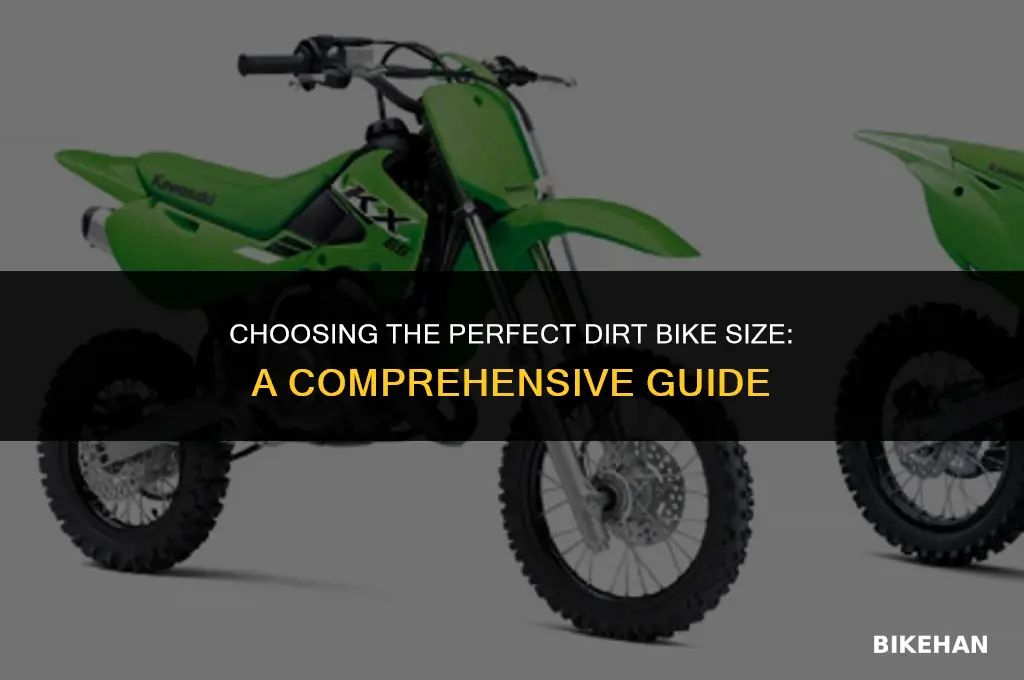
Choosing the right size of dirt bike is crucial for both safety and performance. The size of a dirt bike is typically determined by its engine displacement, which ranges from 50cc for beginners to over 450cc for professional riders. To figure out what size of dirt bike you need, consider your experience level, height, weight, and the type of riding you plan to do. Beginners should start with a smaller bike to learn the basics, while more experienced riders can opt for larger bikes with more power. Additionally, your height and weight play a significant role in determining the right bike size, as you need to be able to touch the ground with both feet when seated. Finally, consider the type of terrain you'll be riding on, as different bike sizes are better suited for different conditions. By taking these factors into account, you can choose a dirt bike that's the perfect fit for you.
Explore related products


What You'll Learn
- Rider's Age and Experience: Consider the rider's skill level and age to determine the appropriate bike size and power
- Height and Weight: Match the bike's seat height and weight capacity to the rider's physical measurements for comfort and control
- Bike Type and Purpose: Choose between motocross, trail, or dual-sport bikes based on the intended riding environment and style
- Engine Size and Power: Select an engine size that suits the rider's experience and the type of terrain they'll be riding on
- Test Rides and Adjustments: Encourage test rides to ensure the bike feels right and make necessary adjustments for a perfect fit

Rider's Age and Experience: Consider the rider's skill level and age to determine the appropriate bike size and power
When selecting a dirt bike, the rider's age and experience level are critical factors that influence the appropriate bike size and power. For younger riders, typically under the age of 12, smaller bikes with lower power outputs are recommended to ensure safety and ease of handling. These bikes often have smaller engines, ranging from 50cc to 110cc, and are designed to be lightweight and maneuverable. As riders progress in age and skill, they can transition to larger bikes with more powerful engines.
For intermediate riders, aged 12 to 16, bikes with engine sizes between 125cc and 250cc are commonly used. These bikes offer a balance between power and control, allowing riders to develop their skills while still being manageable. It's important to note that the power output of the bike should also be considered, as some 250cc bikes can be quite powerful and may not be suitable for all riders in this age group.
Experienced riders, typically over the age of 16, can opt for larger bikes with engine sizes ranging from 250cc to 450cc or more. These bikes are designed for high performance and are capable of handling more challenging terrain. However, even experienced riders should exercise caution when selecting a bike, as larger engines can be more difficult to control and may require additional skill to handle safely.
In addition to age and experience, other factors such as the rider's height and weight should also be considered when selecting a bike size. Manufacturers often provide guidelines for bike sizing based on these factors, which can help ensure a proper fit and improve the rider's comfort and control.
Ultimately, the key to selecting the right dirt bike size and power is to carefully consider the rider's individual needs and abilities. By taking into account factors such as age, experience, height, and weight, riders can find a bike that is well-suited to their skill level and riding style, ensuring a safer and more enjoyable experience on the trails.
Mastering the Mix: Fueling Your Two-Stroke Dirt Bike for Optimal Performance
You may want to see also
Explore related products




Height and Weight: Match the bike's seat height and weight capacity to the rider's physical measurements for comfort and control
To ensure a proper fit on a dirt bike, it's crucial to match the bike's seat height and weight capacity to the rider's physical measurements. This not only enhances comfort during the ride but also ensures better control and safety. Here's how to go about it:
First, measure the rider's height without shoes. Stand the rider against a wall with their feet shoulder-width apart and mark the point where the top of their head meets the wall. This measurement will give you the rider's standing height. Next, subtract about 10 inches from this measurement to estimate the rider's seated height, which is the distance from the ground to the top of their thighs when seated.
Now, compare this seated height to the bike's seat height. The seat height of a dirt bike is typically measured from the ground to the top of the seat. Ideally, the rider's seated height should be slightly less than the bike's seat height, allowing for a comfortable reach to the ground with both feet. If the rider's seated height is significantly less than the bike's seat height, it may be difficult for them to touch the ground with both feet, which can affect balance and control.
In addition to seat height, it's important to consider the bike's weight capacity. Most dirt bikes have a weight limit specified by the manufacturer. This limit should not be exceeded as it can affect the bike's performance and safety. To determine if the rider's weight is within the bike's capacity, simply weigh the rider and compare their weight to the manufacturer's specifications.
If the rider's weight exceeds the bike's capacity, it may be necessary to look for a larger bike or consider a different model with a higher weight limit. On the other hand, if the rider is significantly lighter than the bike's weight capacity, it may be possible to adjust the suspension to better suit their weight, providing a more comfortable and controlled ride.
In conclusion, matching the bike's seat height and weight capacity to the rider's physical measurements is essential for a comfortable and safe dirt biking experience. By following these steps, you can ensure that the rider has the best possible fit on their bike, enhancing their enjoyment and performance on the trails.
Mastering the Art of Donuting on a Dirt Bike: A Step-by-Step Guide
You may want to see also
Explore related products


Bike Type and Purpose: Choose between motocross, trail, or dual-sport bikes based on the intended riding environment and style
Choosing the right type of dirt bike is crucial for both performance and safety. The three main categories to consider are motocross, trail, and dual-sport bikes, each designed for specific riding environments and styles. Motocross bikes are lightweight and agile, built for speed and maneuverability on closed dirt tracks. They have long suspension travel to absorb jumps and bumps, but their tires and suspension are not suited for long-distance trail riding. Trail bikes, on the other hand, are designed for off-road exploration and endurance. They have more robust frames, better ground clearance, and tires that provide traction on a variety of terrains. Dual-sport bikes bridge the gap between motocross and trail bikes, offering a balance of performance and versatility. They are suitable for both on-road and off-road riding, making them a popular choice for riders who want a single bike for multiple purposes.
When selecting a bike type, consider your intended riding environment and style. If you plan to ride on closed tracks and prioritize speed and agility, a motocross bike is the best choice. For off-road adventures and long-distance trail riding, a trail bike is more appropriate. If you want a bike that can handle both on-road and off-road conditions, a dual-sport bike is the way to go. Additionally, consider factors such as your skill level, physical fitness, and the type of terrain you will be riding on. Each bike type has its own unique characteristics and requirements, so it's essential to choose one that aligns with your riding goals and abilities.
In addition to bike type, it's important to consider the size and fit of the bike. The size of a dirt bike is typically determined by its engine displacement, seat height, and overall dimensions. A bike that is too large or too small can be difficult to control and may lead to discomfort or injury. To determine the right size, measure your height and inseam, and compare these measurements to the manufacturer's specifications. It's also a good idea to test ride different bikes to find one that feels comfortable and suits your riding style. Remember, the right bike type and size will vary depending on your individual needs and preferences, so take the time to research and test ride before making a decision.
Dirt Bike Wheel Fitment Guide: Find Your Perfect Match
You may want to see also
Explore related products




Engine Size and Power: Select an engine size that suits the rider's experience and the type of terrain they'll be riding on
Selecting the right engine size for a dirt bike is crucial as it directly impacts the bike's power output and overall performance. For beginners, it's advisable to start with a smaller engine, typically around 125cc to 250cc, to ensure easier control and maneuverability. These engines provide sufficient power for learning the basics of dirt biking without overwhelming the rider. As riders gain experience and confidence, they can consider upgrading to larger engines, such as 450cc or even 500cc, which offer more power and are better suited for challenging terrains and competitive racing.
The type of terrain also plays a significant role in determining the appropriate engine size. For off-road trails with steep inclines and rough surfaces, a bike with a larger engine and higher torque is preferable, as it provides the necessary power to tackle these obstacles. On the other hand, for smoother tracks or motocross courses, a smaller, more agile engine might be more beneficial, allowing for quicker acceleration and better handling.
It's important to note that engine size is not the only factor affecting a dirt bike's performance. Other components, such as the suspension, tires, and overall bike weight, also contribute to the bike's capabilities. Therefore, when selecting an engine size, it's essential to consider the entire package and how each component will work together to meet the rider's needs and preferences.
In summary, choosing the right engine size for a dirt bike involves a careful consideration of the rider's experience level and the type of terrain they will be riding on. By selecting an engine that matches these factors, riders can ensure a more enjoyable and safe dirt biking experience.
Dirt Bike Tumbles: A Guide to Safe Falling Techniques
You may want to see also
Explore related products


Test Rides and Adjustments: Encourage test rides to ensure the bike feels right and make necessary adjustments for a perfect fit
Once you've narrowed down the potential size range of your dirt bike based on height and weight charts, the next crucial step is to take it for a test ride. This hands-on approach allows you to assess how the bike feels under real-world conditions and make any necessary adjustments for a perfect fit.
During the test ride, pay close attention to several key factors. First, consider the bike's overall handling and maneuverability. Does it feel too bulky or too small for your body? Are you able to easily reach the handlebars and foot pegs? Next, evaluate the suspension and braking systems. Do they provide a smooth and responsive ride? Are you able to stop quickly and safely?
After the test ride, make any necessary adjustments to the bike's setup. This may include altering the seat height, adjusting the handlebar position, or fine-tuning the suspension settings. Remember, a properly fitted dirt bike should feel comfortable and intuitive to ride, allowing you to focus on your technique and the terrain ahead.
It's also important to consider the type of riding you'll be doing when making adjustments. For example, if you plan on tackling rough trails or performing jumps, you may want to opt for a slightly larger bike with more suspension travel. Conversely, if you'll be riding on smoother surfaces or performing technical maneuvers, a smaller bike with a more responsive suspension may be preferable.
Ultimately, the goal of test rides and adjustments is to find a dirt bike that feels like an extension of your body. By taking the time to properly fit your bike, you'll be able to ride with greater confidence, control, and enjoyment, whether you're a seasoned pro or a beginner just starting out.
Mastering the Art of Double Jumping on Your Dirt Bike
You may want to see also
Frequently asked questions
To determine the right size of a dirt bike for your height, you should consider the seat height and the overall size of the bike. For adults, a general rule of thumb is that the seat height should be around 37-39 inches from the ground. For children, the seat height should be lower, around 26-30 inches. Additionally, consider the bike's wheelbase and handlebar height to ensure a comfortable riding position.
When choosing a dirt bike size for off-road riding, consider the type of terrain you'll be riding on, your skill level, and your body weight. For rough terrain, a larger bike with more suspension travel may be preferable. For beginners, a smaller, lighter bike may be easier to handle. Your body weight also plays a role, as a heavier rider may need a larger bike with more power.
Yes, dirt bikes are generally categorized into different size classes based on engine displacement and seat height. These categories include mini bikes (50cc-110cc), youth bikes (125cc-250cc), and adult bikes (250cc-450cc). Within each category, there may be variations in seat height and overall size to accommodate different rider heights and preferences.
To test the size of a dirt bike before purchasing, visit a local dealership and sit on the bike. Check if your feet can touch the ground comfortably while seated, and if you can reach the handlebars and controls easily. Take the bike for a test ride if possible, to see how it feels in motion and if it's the right size for your riding style and preferences.
While you can make some adjustments to your dirt bike after purchase, such as changing the seat height or handlebar position, the overall size of the bike is generally fixed. If you find that the bike is too small or too large after purchase, you may need to consider selling it and buying a different size that better suits your needs.