Megan Blake
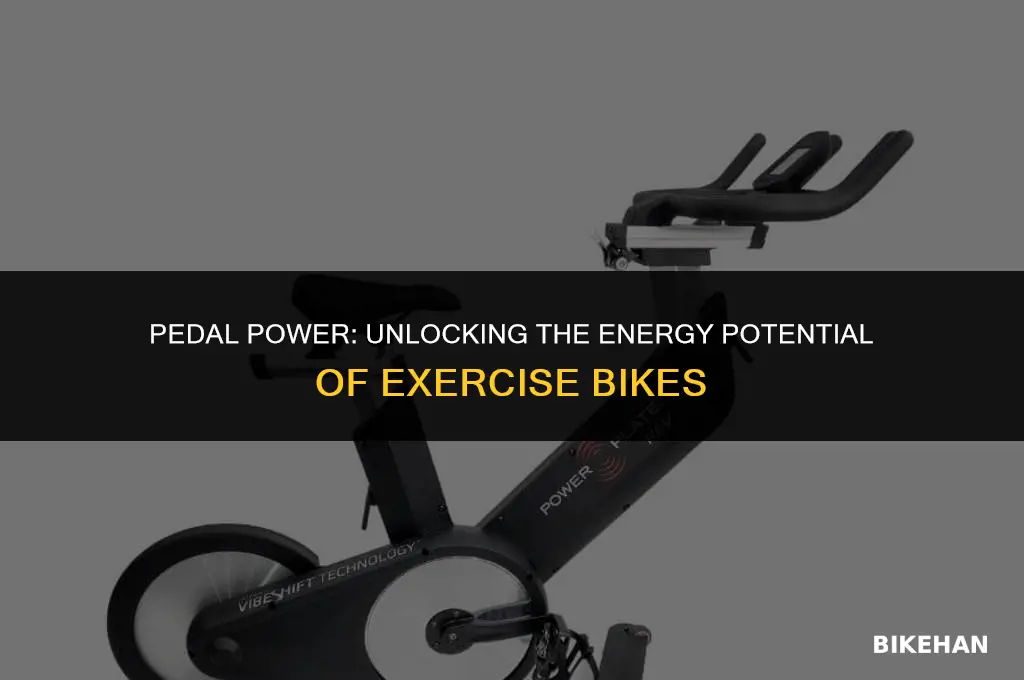
Exercise bikes are a popular piece of fitness equipment that not only provide an effective cardiovascular workout but also generate power during use. This power is produced by the user's pedaling motion, which drives a generator or alternator within the bike. The amount of power generated depends on several factors, including the user's weight, pedaling speed, and resistance level. On average, an exercise bike can produce anywhere from 100 to 300 watts of power, which is enough to charge small electronic devices or even power a television. However, the actual power output can vary significantly depending on the specific model and features of the bike, as well as the user's individual characteristics and workout intensity.
Explore related products


What You'll Learn

Factors Affecting Power Output
The power output of an exercise bike is influenced by several key factors, each playing a crucial role in determining the overall efficiency and effectiveness of the workout. One primary factor is the resistance level set on the bike. Higher resistance levels require more effort from the user, thereby increasing the power output. This is because the bike's mechanism works harder to provide the necessary resistance, translating the user's pedaling force into measurable power.
Another significant factor is the cadence or pedaling speed of the user. Maintaining a higher cadence can lead to increased power output as the bike's flywheel or resistance mechanism is engaged more frequently. This results in a greater amount of energy being converted into power. Additionally, the duration of the workout can impact power output. As the workout progresses, the user may experience fatigue, leading to a decrease in pedaling efficiency and, consequently, a reduction in power output.
The design and quality of the exercise bike itself also play a role in power output. Bikes with more advanced mechanisms, such as direct-contact resistance or magnetic resistance systems, can provide a more consistent and accurate power output compared to older models with less sophisticated mechanisms. Furthermore, the weight and balance of the flywheel can affect the bike's ability to maintain a steady power output, especially during intense workouts.
Environmental factors, such as temperature and humidity, can also influence power output. High temperatures and humidity levels can cause the user to sweat more and become dehydrated, leading to a decrease in performance and power output. Proper hydration and maintaining a comfortable workout environment are essential to mitigate these effects.
Lastly, the user's physical fitness level and training goals are critical factors. More experienced users with higher fitness levels can generate greater power output due to their increased muscle strength and endurance. Conversely, beginners or those with lower fitness levels may need to work up to higher power outputs gradually. Understanding these factors can help users optimize their workouts and achieve their fitness goals more effectively.
Peloton Bike Power Consumption: WiFi Connectivity Insights
You may want to see also
Explore related products


Average Power Generated
The average power generated by an exercise bike can vary significantly depending on several factors, including the type of bike, the intensity of the workout, and the user's physical condition. Typically, a standard exercise bike can produce anywhere from 100 to 300 watts of power during a vigorous workout session. This range is sufficient for most home users and can provide an effective cardiovascular workout.
For a more precise calculation, one can consider the formula for power output on an exercise bike: Power (watts) = Force (newtons) x Distance (meters) / Time (seconds). The force exerted by the user on the pedals, the distance covered during the workout, and the time taken to cover that distance all contribute to the overall power generated.
It's important to note that the power output of an exercise bike is not constant throughout a workout session. It can fluctuate based on the user's pedaling speed, resistance level, and workout intensity. For instance, during a high-intensity interval training (HIIT) session, the power output may spike significantly during the intense intervals and then drop during the recovery periods.
To maximize the power generated during a workout, users can focus on maintaining a consistent pedaling cadence, increasing the resistance level, and incorporating interval training into their routine. Additionally, ensuring proper bike maintenance, such as keeping the chain lubricated and the flywheel clean, can help optimize power output.
In summary, the average power generated by an exercise bike is influenced by various factors, including the bike's design, the user's workout intensity, and their physical condition. By understanding these factors and implementing strategies to maximize power output, users can enhance the effectiveness of their exercise bike workouts.
Exploring the Cost of Powder Coating Your Bike Frame
You may want to see also
Explore related products


Peak Power Capabilities
The peak power capabilities of an exercise bike are a critical factor to consider for those looking to maximize their workout efficiency. Unlike continuous power output, which is the sustained energy an exercise bike can produce over a period, peak power refers to the maximum burst of energy that can be generated at any given moment. This is particularly important for high-intensity interval training (HIIT) where short bursts of maximum effort are required.
To understand the peak power capabilities of an exercise bike, one must look at the bike's resistance mechanism and drive system. Bikes with direct-contact resistance, where the resistance pads directly touch the flywheel, typically offer higher peak power outputs due to the immediate transfer of energy. On the other hand, bikes with magnetic resistance, while quieter and requiring less maintenance, may have slightly lower peak power outputs but offer a smoother and more consistent resistance curve.
The drive system also plays a significant role. Bikes with a belt drive system tend to provide a more realistic cycling feel and can handle higher peak power outputs without slipping. Chain drive systems, while less common in modern exercise bikes, can also offer high peak power capabilities but require more maintenance.
Manufacturers often list the peak power output of their exercise bikes in watts. For instance, a high-end exercise bike might boast a peak power output of 2000 watts or more, which is sufficient for even the most intense workouts. However, it's essential to consider not just the peak power but also the bike's ability to sustain that power output over time.
In practical terms, the peak power capabilities of an exercise bike can significantly impact the effectiveness of your workout. For cyclists training for competitive events, the ability to simulate the peak power demands of a race can be invaluable. Similarly, for fitness enthusiasts looking to improve their cardiovascular health or burn calories, a bike with high peak power output can provide a more challenging and rewarding workout experience.
When selecting an exercise bike, it's crucial to consider your specific needs and goals. If peak power output is a priority, look for bikes with robust resistance mechanisms and drive systems that can handle high-intensity workouts. Additionally, consider the bike's overall durability, comfort, and features such as adjustable resistance levels and workout programs to ensure it meets your long-term fitness needs.
Pocket Bike Prices in the Philippines: A Comprehensive Guide
You may want to see also
Explore related products


Power Measurement Methods
To measure the power output of an exercise bike accurately, several methods can be employed, each with its own advantages and limitations. One common approach is to use a direct drive system, where the bike's flywheel is connected to a generator or alternator. As the user pedals, the mechanical energy is converted into electrical energy, which can then be measured and displayed. This method is relatively straightforward and can provide real-time power output data, but it may not account for factors such as air resistance and the efficiency of the drivetrain.
Another method is to use a strain gauge or force sensor to measure the force applied to the pedals. By multiplying the force by the cadence (pedaling speed), power output can be calculated. This method is more accurate in terms of capturing the user's actual effort, but it can be more complex to implement and may require additional components.
For a more comprehensive assessment, some exercise bikes use a combination of direct drive and strain gauge methods. This hybrid approach can provide a more accurate and detailed picture of the user's power output, taking into account both the mechanical energy generated and the force applied. However, it also increases the complexity and cost of the system.
In addition to these methods, some exercise bikes may use algorithms to estimate power output based on factors such as speed, resistance, and user weight. While these estimates can be useful, they are generally less accurate than direct measurements and may not account for individual differences in efficiency and technique.
When choosing an exercise bike, it's important to consider the power measurement method used, as it can impact the accuracy and usefulness of the data provided. For serious athletes or those looking to track their progress closely, a bike with a direct drive or hybrid system may be preferable. For casual users, an estimated power output may be sufficient.
Exploring the Power Dynamics of 250W vs 500W Pedal Assist E-Bikes
You may want to see also
Explore related products


Applications of Generated Power
The power generated by an exercise bike can be harnessed for various practical applications, transforming physical effort into usable energy. One innovative use is in powering small electronic devices, such as smartphones, tablets, or even household appliances. By connecting the bike to a generator or a battery storage system, individuals can convert their workout sessions into a sustainable power source, reducing reliance on traditional electricity grids.
In addition to powering devices, the generated power can be utilized in educational settings to demonstrate principles of energy conversion and sustainability. Schools and universities can incorporate exercise bikes into their curricula, allowing students to engage in hands-on experiments that showcase the relationship between human effort, mechanical energy, and electrical power. This approach not only promotes physical fitness but also fosters a deeper understanding of energy dynamics and environmental responsibility.
Furthermore, the power output of exercise bikes can be employed in fitness centers and gyms to offset their energy consumption. By integrating multiple bikes into a centralized power generation system, these facilities can reduce their carbon footprint and potentially lower their operating costs. This application not only benefits the environment but also encourages gym-goers to contribute to a more sustainable fitness ecosystem.
Another potential application is in emergency preparedness and disaster relief scenarios. Exercise bikes can serve as a reliable source of power in situations where traditional energy sources are unavailable. By having a fleet of bikes equipped with generators, emergency responders can ensure a continuous supply of electricity for critical operations, such as powering medical equipment, communication devices, or lighting systems.
Lastly, the power generated by exercise bikes can be used to support remote or off-grid communities. In areas where access to electricity is limited, exercise bikes can provide a means for individuals to generate their own power, enhancing their quality of life and enabling access to essential services and information. This application highlights the potential for exercise bikes to contribute to global development and social equity.
Pedal Power: Unveiling the Energy Potential of Bike Dynamos
You may want to see also
Frequently asked questions
The power output of an exercise bike varies depending on the model and the intensity of the workout. On average, a stationary exercise bike can produce between 100 to 300 watts during a vigorous session.
Several factors can influence the power output of an exercise bike, including the resistance level set by the user, the speed at which the pedals are turned, the weight of the user, and the efficiency of the bike's design. Higher resistance and faster pedaling generally result in greater power output.
Some modern exercise bikes are equipped with technology that allows them to generate electricity, which can then be used to charge devices like phones or tablets. However, the amount of power generated is usually quite low and may not be sufficient to charge devices quickly.
Compared to other forms of exercise equipment, such as treadmills or ellipticals, exercise bikes generally produce less power. This is because the motion of cycling is more efficient and requires less energy to maintain, resulting in lower power output.