 Samantha Lee
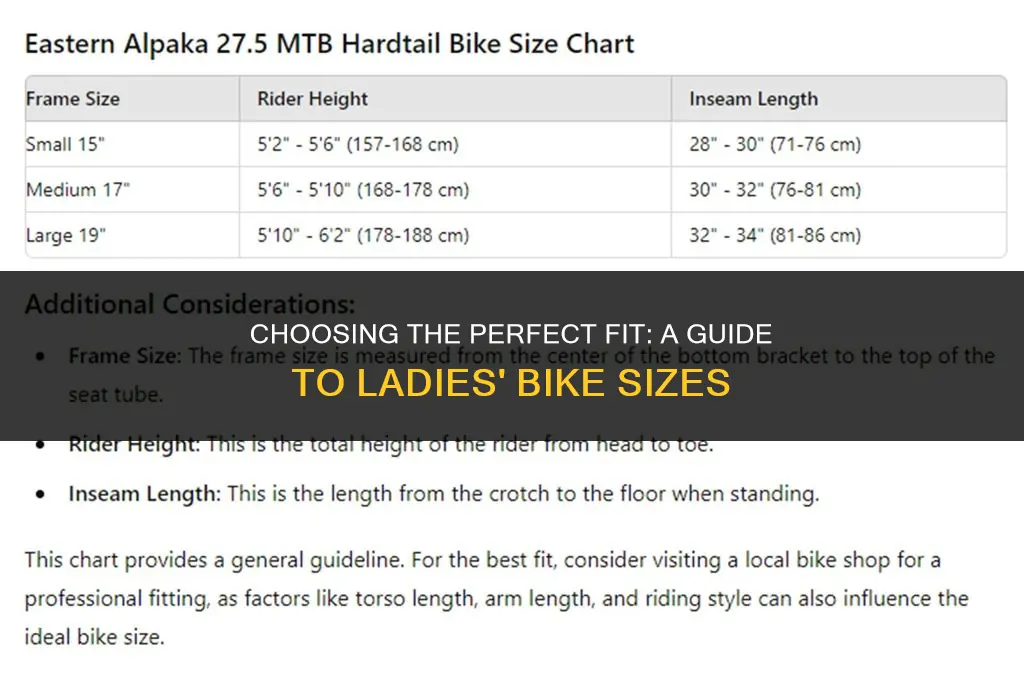
When it comes to choosing the right size for a ladies' bike, several factors come into play to ensure comfort, safety, and efficiency while riding. Bike sizes are typically determined by the frame size, which is measured from the center of the bottom bracket to the top of the seat tube. For women, bike frames generally range from 47 to 57 centimeters, with some models available in smaller or larger sizes to accommodate different body types. In addition to frame size, other important considerations include the reach to the handlebars, the saddle height, and the overall geometry of the bike, which can affect the rider's posture and pedaling efficiency. Proper bike sizing is crucial for preventing injuries and enhancing the overall cycling experience, so it's essential to consult with a knowledgeable bike fitter or retailer to find the ideal size for your specific needs and measurements.
Explore related products


What You'll Learn
- Frame Size: Understanding the different frame sizes available for women's bikes and how they impact comfort and performance
- Wheel Size: Exploring the various wheel sizes used in ladies' bikes, such as 26, 27.5, and 29, and their effects on handling
- Seat Height: Adjusting the seat height for optimal leg extension and comfort during cycling, tailored to the rider's height
- Handlebar Reach: Ensuring the handlebars are at an appropriate distance from the rider to prevent strain on the arms and shoulders
- Bike Type: Considering the type of bike (e.g., road, mountain, hybrid) and how it influences the ideal size for a female rider

Frame Size: Understanding the different frame sizes available for women's bikes and how they impact comfort and performance
Women's bike frames come in a variety of sizes, typically ranging from extra small (XS) to extra large (XL). The most common sizes are small (S), medium (M), and large (L). Frame size is determined by the length of the seat tube, which is the tube that connects the seat post to the bottom bracket. The length of the seat tube affects the overall geometry of the bike, including the reach to the handlebars, the height of the seat, and the length of the wheelbase.
Choosing the right frame size is crucial for both comfort and performance. A frame that is too small can lead to a cramped riding position, while a frame that is too large can make it difficult to reach the handlebars and control the bike. The ideal frame size will allow the rider to sit comfortably on the seat with their feet flat on the ground and their knees slightly bent. When pedaling, the rider's leg should be almost fully extended at the bottom of the stroke.
In addition to comfort, frame size also affects the bike's handling and stability. A smaller frame is generally more maneuverable and easier to handle, while a larger frame is more stable at high speeds and on rough terrain. However, these are generalizations and the actual handling characteristics of a bike will depend on a variety of factors, including the frame material, the wheel size, and the overall geometry.
To determine the right frame size, riders can use a sizing chart or visit a local bike shop for a professional fitting. Sizing charts typically use the rider's height and inseam length to estimate the appropriate frame size. However, it's important to note that these charts are only a starting point and may not account for individual differences in body proportions and riding preferences.
Ultimately, the best way to find the right frame size is to test ride a variety of bikes and see which one feels the most comfortable and responsive. Riders should pay attention to how the bike feels when they are sitting on the seat, reaching for the handlebars, and pedaling. By taking the time to find the right frame size, riders can ensure that their bike is both comfortable and performs well.
Understanding Bike Frame Sizes: A Guide to 19-Inch Frames
You may want to see also
Explore related products


Wheel Size: Exploring the various wheel sizes used in ladies' bikes, such as 26, 27.5, and 29, and their effects on handling
Ladies bikes come in various wheel sizes, each offering distinct advantages and affecting the bike's handling characteristics. The most common wheel sizes for ladies bikes are 26 inches, 27.5 inches, and 29 inches. Understanding the differences between these wheel sizes is crucial for selecting the right bike for your needs.
Starting with the smallest option, 26-inch wheels are often found on traditional ladies bikes and are known for their maneuverability and ease of handling. These wheels are ideal for riders who prioritize agility and quick turns, making them suitable for urban commuting and casual riding. However, they may not be the best choice for off-road adventures or rough terrain, as they can struggle with obstacles and uneven surfaces.
Moving up to 27.5-inch wheels, also known as 650b wheels, we find a middle ground between the agility of 26-inch wheels and the stability of 29-inch wheels. These wheels offer a good balance of handling and rolling efficiency, making them versatile for various riding conditions. They are particularly popular among mountain bikers who need a bike that can handle both technical trails and longer descents.
Finally, 29-inch wheels, or 29ers, are the largest option and provide the most stability and rolling efficiency. These wheels are excellent for off-road riding, as they can easily overcome obstacles and maintain momentum on rough terrain. However, they may feel less agile and more challenging to maneuver in tight spaces compared to smaller wheel sizes.
When choosing a wheel size for your ladies bike, consider your riding style, the terrain you'll be riding on, and your personal preferences. If you prioritize agility and quick handling, a 26-inch wheel may be the best choice. For a balance of handling and stability, a 27.5-inch wheel is a great option. And if you're an avid off-road rider who values stability and rolling efficiency, a 29-inch wheel is likely the way to go.
Understanding BMX Bike Tube Sizes: A Comprehensive Guide
You may want to see also
Explore related products


Seat Height: Adjusting the seat height for optimal leg extension and comfort during cycling, tailored to the rider's height
To determine the optimal seat height for a cyclist, it's essential to consider both leg extension and comfort. The seat height should allow the rider to extend their legs fully without straining, ensuring that the knees are slightly bent at the bottom of the pedal stroke. This position maximizes power output and minimizes the risk of injury. For women, who typically have shorter inseams than men, finding the right seat height is crucial for an efficient and comfortable ride.
One method to adjust the seat height is the 'heel-to-pedal' technique. The rider should sit on the bike with their feet on the pedals and their heels resting on the pedal's surface. If the heels can touch the ground with the pedals at the 6 o'clock position, the seat height is likely correct. If not, the seat should be lowered or raised accordingly. Another approach is the 'knee-over-pedal' method, where the rider's knee should be directly over the pedal axle when the pedal is at the 3 o'clock position. This method helps ensure proper alignment and reduces strain on the knee joint.
Comfort is also a key factor in determining seat height. The rider should be able to sit comfortably without feeling pressure on the perineal area. If discomfort persists, it may be necessary to adjust the seat height or consider a different saddle design. Additionally, the rider's body position should be upright and relaxed, with elbows slightly bent and hands comfortably gripping the handlebars.
In summary, adjusting the seat height for optimal leg extension and comfort is essential for female cyclists. By using methods such as the 'heel-to-pedal' or 'knee-over-pedal' techniques and prioritizing comfort, riders can find the ideal seat height for their individual needs. This not only enhances performance but also reduces the risk of injury and ensures a more enjoyable cycling experience.
Adult Bike Sizes: A Comprehensive Guide for Cyclists
You may want to see also
Explore related products


$9.99 $12.99


Handlebar Reach: Ensuring the handlebars are at an appropriate distance from the rider to prevent strain on the arms and shoulders
To determine the ideal handlebar reach on a ladies' bike, start by considering the rider's height and arm length. Generally, the handlebars should be positioned so that the rider can comfortably reach them without stretching or bending their arms excessively. A good rule of thumb is to have the handlebars at or slightly below shoulder height when the rider is seated on the bike.
Next, consider the type of riding the bike will be used for. For example, if the bike is intended for long-distance touring or commuting, the handlebars should be positioned to allow for a more upright riding posture, reducing strain on the back and shoulders. Conversely, if the bike is intended for racing or aggressive riding, the handlebars can be positioned lower to allow for a more aerodynamic posture.
When adjusting the handlebar reach, it's important to also consider the saddle height and fore-aft position. The saddle should be positioned so that the rider's feet can comfortably reach the pedals, and the fore-aft position should allow for a slight bend in the knees when pedaling. Once the saddle position is optimized, the handlebar reach can be fine-tuned to ensure a comfortable and efficient riding position.
In addition to these factors, it's also important to consider any accessories or modifications that may affect the handlebar reach. For example, if the bike is equipped with a suspension fork, this can alter the handlebar height and reach. Similarly, if the rider prefers to use bar ends or grips, these can also affect the overall handlebar reach.
To prevent strain on the arms and shoulders, it's crucial to avoid handlebars that are too far away or too close to the rider. Handlebars that are too far away can cause the rider to stretch their arms excessively, leading to fatigue and discomfort. Conversely, handlebars that are too close can cause the rider to hunch over, putting unnecessary strain on the shoulders and back.
By taking these factors into account and making the necessary adjustments, riders can ensure that their handlebars are at an appropriate distance, promoting a comfortable and efficient riding experience.
Understanding Biker Club Patch Sizes: A Comprehensive Guide
You may want to see also
Explore related products


$14.99 $24.99

$9.99 $12.99

$9.99 $12.99


Bike Type: Considering the type of bike (e.g., road, mountain, hybrid) and how it influences the ideal size for a female rider
Road bikes are designed for speed and efficiency on paved surfaces. For female riders, the ideal size of a road bike typically ranges from 47 to 57 cm in frame size. This range accommodates the average height and reach of female cyclists, ensuring a comfortable and aerodynamic riding position. When selecting a road bike, it's essential to consider the rider's height, inseam length, and reach to the handlebars to find the best fit.
Mountain bikes, on the other hand, are built for off-road adventures and rugged terrain. The ideal size for a female rider on a mountain bike usually falls between 13 and 17 inches in frame size. This range allows for better control and maneuverability on uneven surfaces. It's crucial to consider the rider's skill level and the type of terrain they will be riding on when choosing a mountain bike size.
Hybrid bikes are versatile and suitable for both on-road and off-road cycling. For female riders, the ideal size of a hybrid bike typically ranges from 15 to 19 inches in frame size. This range provides a balance between comfort and efficiency for various riding conditions. When selecting a hybrid bike, it's important to consider the rider's intended use and the type of terrain they will be riding on.
In addition to frame size, other factors such as saddle height, handlebar width, and pedal position should also be considered when choosing a bike for a female rider. Proper bike fit is essential for comfort, performance, and injury prevention. It's recommended to consult with a professional bike fitter or a knowledgeable salesperson to ensure the best fit for the rider's specific needs and preferences.
Understanding BMC Bike Frame Sizes: A Guide to 57cm Frames
You may want to see also
Frequently asked questions
Ladies' bikes generally come in sizes ranging from 48 cm to 56 cm in frame size, which corresponds to wheel sizes of 24 inches to 29 inches.
To determine the right size, measure your inseam length and compare it to the bike manufacturer's sizing chart. Your inseam length should match the standover height of the bike for a comfortable fit.
Yes, ladies' bikes come in various types such as road bikes, mountain bikes, hybrid bikes, and cruiser bikes. Each type may have a slightly different size range and fit.
Yes, the seat height on most ladies' bikes is adjustable. You can raise or lower the seat to ensure your feet can touch the ground comfortably when seated.
Yes, there are differences in sizing between ladies' and men's bikes. Ladies' bikes typically have smaller frame sizes and shorter top tubes to accommodate the average female body proportions.


