Eric Johnson
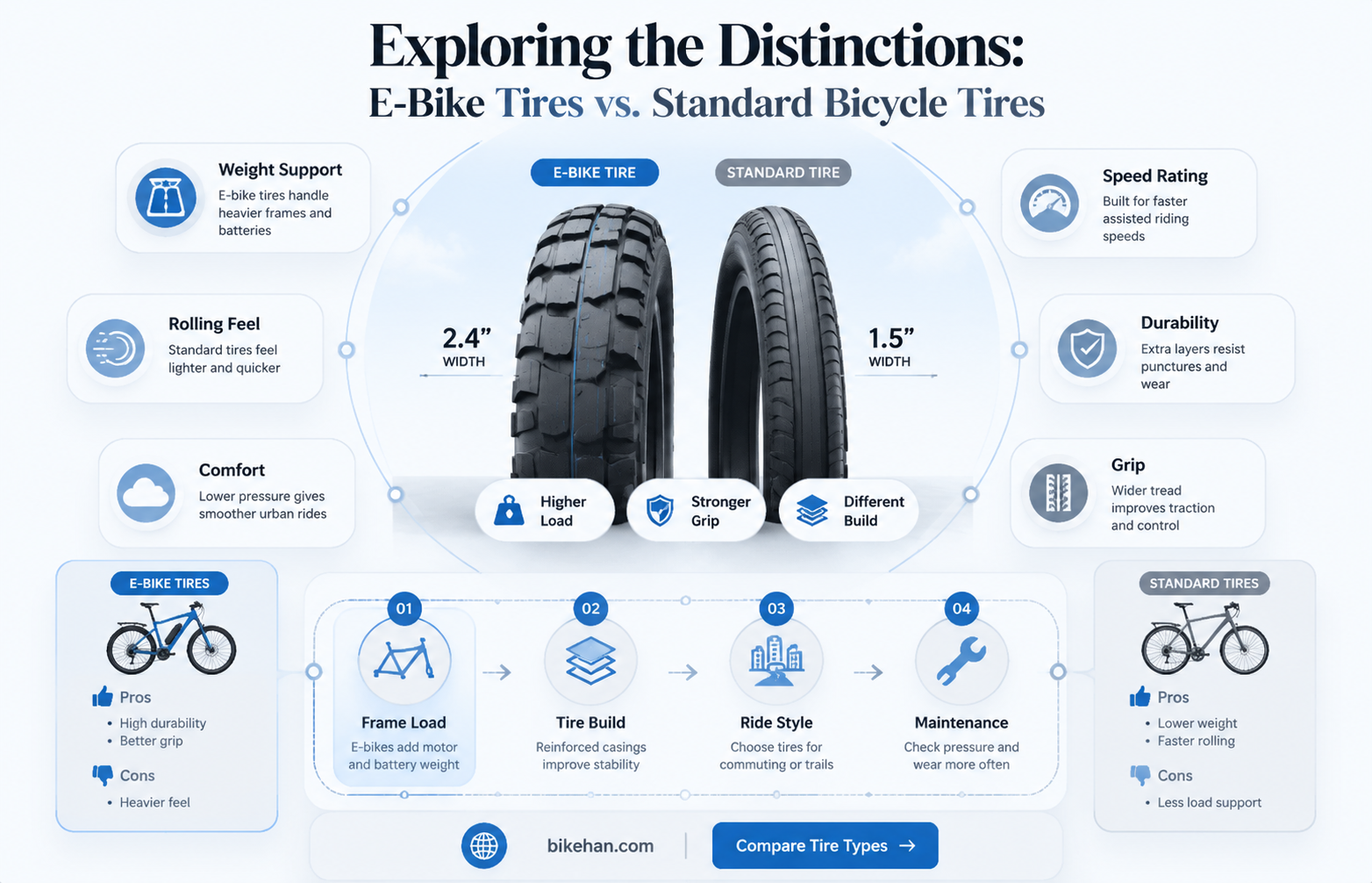
Electric bike tires, commonly referred to as e-bike tires, are specifically designed to meet the unique demands of electric bicycles. Unlike standard bicycle tires, e-bike tires must accommodate higher speeds, increased weight, and the additional torque generated by electric motors. They often feature reinforced sidewalls and a more robust construction to handle the extra stress. Additionally, e-bike tires may have a different tread pattern to provide better traction and stability at higher speeds. While standard bike tires can vary widely in terms of size, material, and intended use, e-bike tires are tailored to ensure safety and performance for riders of electric bicycles.
| Characteristics | Values |
|---|---|
| Tire Width | E-bike tires are generally wider (2.0-2.4 inches) compared to standard bike tires (1.75-2.0 inches) |
| Tread Pattern | E-bike tires have a more aggressive tread pattern for better grip and traction, while standard tires may have a smoother tread |
| Puncture Resistance | E-bike tires often have better puncture resistance due to their thicker sidewalls and additional layers |
| Rolling Resistance | E-bike tires tend to have lower rolling resistance to improve efficiency and battery life |
| Weight | E-bike tires are typically heavier than standard bike tires due to their larger size and additional features |
| Pressure | E-bike tires can be inflated to higher pressures (up to 50 PSI) compared to standard tires (typically 30-40 PSI) |
| Compatibility | E-bike tires are designed to fit specific e-bike models and may not be compatible with standard bicycles |
| Purpose | E-bike tires are optimized for electric bicycles, providing better performance and durability, while standard tires are designed for traditional bicycles |
| Construction | E-bike tires often feature additional layers and reinforcements to handle the increased demands of electric bicycles |
| Price | E-bike tires are generally more expensive than standard bike tires due to their specialized design and features |
Explore related products


What You'll Learn
- Tire Width and Tread: E-bike tires are wider with deeper treads for better grip and stability
- Material and Puncture Resistance: E-bike tires use stronger materials and have enhanced puncture resistance to handle higher speeds and loads
- Reflectivity and Visibility: E-bike tires often feature reflective strips or sidewalls for increased visibility during low-light conditions
- Weight and Rolling Resistance: E-bike tires are designed to balance weight and rolling resistance for efficient energy use
- Compatibility and Installation: E-bike tires may have specific compatibility requirements and installation procedures due to their unique design

Tire Width and Tread: E-bike tires are wider with deeper treads for better grip and stability
E-bike tires are designed with a wider profile and deeper treads compared to standard bicycle tires. This design choice is crucial for several reasons. Firstly, the increased width provides a larger contact patch with the road, which enhances grip and stability, especially when cornering or riding on uneven surfaces. This is particularly important for e-bikes, which often have higher torque and can accelerate more quickly than traditional bicycles, necessitating better traction to maintain control.
The deeper treads on e-bike tires also play a significant role in improving grip. They help to channel water away from the tire's contact patch, reducing the risk of hydroplaning on wet roads. Additionally, the deeper treads can bite into softer surfaces like gravel or dirt, providing better traction in a variety of riding conditions. This is essential for e-bikes, which are often used for commuting and may need to navigate through different types of terrain.
Another benefit of the wider and deeper tread design is improved puncture resistance. E-bike tires are more likely to encounter debris on the road due to their higher speeds and the fact that they are often ridden in urban environments where roads can be littered with sharp objects. The increased width and deeper treads help to distribute the force of impacts more evenly, reducing the likelihood of a puncture.
In terms of practical tips, it's important to note that e-bike tires require more air pressure than standard bicycle tires to maintain their shape and provide optimal performance. Riders should regularly check and adjust the tire pressure according to the manufacturer's recommendations. Additionally, due to the unique design of e-bike tires, it's crucial to replace them with tires specifically designed for e-bikes when they wear out. Using standard bicycle tires on an e-bike can compromise safety and performance.
In conclusion, the wider profile and deeper treads of e-bike tires are essential features that enhance grip, stability, and puncture resistance, making them well-suited for the demands of electric bicycle riding. By understanding these differences and properly maintaining their tires, e-bike riders can ensure a safer and more enjoyable riding experience.
Explore related products


Material and Puncture Resistance: E-bike tires use stronger materials and have enhanced puncture resistance to handle higher speeds and loads
E-bike tires are engineered with stronger materials and enhanced puncture resistance to withstand the higher speeds and loads associated with electric bicycles. This is crucial because e-bikes often travel at higher speeds than traditional bicycles and carry additional weight from the electric motor and battery. Standard bicycle tires, while suitable for regular bikes, may not be able to handle these increased demands, making them more prone to punctures and wear.
One of the key materials used in e-bike tires is Kevlar, a synthetic fiber known for its high strength-to-weight ratio. Kevlar is often incorporated into the tire's puncture protection layer, providing an extra barrier against sharp objects and debris. Additionally, e-bike tires may feature a thicker rubber compound, which not only enhances puncture resistance but also improves durability and longevity.
Another important aspect of e-bike tires is their ability to handle higher pressures. Higher tire pressures can improve efficiency and reduce the risk of punctures, but they also require tires that can withstand the increased stress. E-bike tires are designed to operate at higher pressures than standard bicycle tires, ensuring a smoother and more efficient ride.
In terms of puncture resistance, e-bike tires often employ a combination of technologies. Some tires feature a puncture protection strip that runs along the center of the tread, while others use a more comprehensive approach, incorporating puncture-resistant materials throughout the entire tire. This can include the use of aramid fibers, which are highly resistant to abrasion and punctures.
Overall, the enhanced material and puncture resistance of e-bike tires make them a critical component for electric bicycle riders. By using stronger materials and advanced puncture protection technologies, e-bike tires can provide a safer and more reliable riding experience, even at higher speeds and loads.
Explore related products


Reflectivity and Visibility: E-bike tires often feature reflective strips or sidewalls for increased visibility during low-light conditions
Reflective strips and sidewalls are a common feature on e-bike tires, designed to enhance visibility during low-light conditions. This safety feature is particularly important for e-bikes, which are often used for commuting and recreational riding in urban environments where visibility to motorists and pedestrians is crucial. The reflective materials used in these tires can vary, but they typically include small glass beads or microprismatic elements that reflect light back to its source, making the bike more noticeable to others on the road.
In contrast, standard bicycle tires may not always include reflective elements, as they are not subject to the same visibility requirements as e-bikes. This is because e-bikes, being motorized, are considered more akin to motor vehicles and are therefore held to higher standards of visibility and safety. As a result, e-bike tires are often designed with additional safety features that are not found on standard bicycle tires.
The increased visibility provided by reflective e-bike tires can be especially beneficial during dawn, dusk, and nighttime riding, when natural light is limited. This feature can help to prevent accidents by alerting motorists and pedestrians to the presence of the e-bike, giving them more time to react and avoid collisions. Additionally, reflective tires can also be useful in poor weather conditions, such as rain or fog, when visibility is further reduced.
It is worth noting that while reflective tires can improve visibility, they are not a substitute for proper lighting and safety gear. E-bike riders should still use front and rear lights, as well as wear reflective clothing and helmets, to ensure maximum visibility and safety while riding. Reflective tires are simply one additional safety feature that can help to make e-bike riding safer and more enjoyable.
In summary, reflective strips and sidewalls are a unique feature of e-bike tires that enhance visibility during low-light conditions, providing an additional layer of safety for e-bike riders. This feature is not typically found on standard bicycle tires, which are not subject to the same visibility requirements as e-bikes. While reflective tires can improve visibility, they should be used in conjunction with other safety measures, such as proper lighting and reflective gear, to ensure maximum safety while riding.
Explore related products


Weight and Rolling Resistance: E-bike tires are designed to balance weight and rolling resistance for efficient energy use
E-bike tires are engineered with a specific focus on optimizing weight and rolling resistance to enhance energy efficiency. This is crucial because the electric motor in an e-bike needs to work in harmony with the tires to provide a smooth and energy-efficient ride. Unlike standard bicycle tires, which may prioritize puncture resistance or grip, e-bike tires must strike a delicate balance between being lightweight enough to reduce the overall weight of the bike and having enough rolling resistance to prevent excessive wear and tear.
One of the key differences between e-bike tires and standard tires is the use of advanced materials and construction techniques. E-bike tires often feature a reinforced sidewall and a harder rubber compound to reduce rolling resistance. This harder compound allows the tire to roll more easily, which is particularly important for e-bikes that are often used for commuting or long-distance rides. Additionally, the tread pattern on e-bike tires is typically designed to provide a good balance between grip and rolling resistance, ensuring that the bike can handle a variety of road conditions while still maintaining efficiency.
Another important aspect of e-bike tires is their impact on the overall performance of the bike. Because e-bikes rely on an electric motor for propulsion, the efficiency of the tires can directly affect the range and speed of the bike. Tires with lower rolling resistance can help the bike to achieve higher speeds with less effort from the motor, which can be particularly beneficial for riders who need to cover long distances or tackle steep hills. Conversely, tires with higher rolling resistance can provide better grip and durability, which may be more suitable for riders who prioritize safety and reliability over speed and efficiency.
In conclusion, the design of e-bike tires is a complex process that involves careful consideration of weight, rolling resistance, and overall performance. By using advanced materials and construction techniques, e-bike tires can provide a unique combination of efficiency, grip, and durability that is tailored to the specific needs of electric bicycle riders.
Explore related products


Compatibility and Installation: E-bike tires may have specific compatibility requirements and installation procedures due to their unique design
E-bike tires are designed to handle the additional demands of electric bicycles, which means they often have unique compatibility requirements and installation procedures. One of the key factors to consider when installing e-bike tires is the rim width. E-bike rims are typically wider than standard bicycle rims to accommodate the larger tires and provide better stability. This means that you'll need to ensure your rims are compatible with the tires you're installing. Additionally, e-bike tires often have a higher recommended inflation pressure than standard tires, which can affect the installation process.
When installing e-bike tires, it's important to follow the manufacturer's instructions carefully. Some e-bike tires may require special tools or techniques to install properly. For example, you may need to use a tire lever to remove the tire from the rim, or you may need to apply a specific type of lubricant to the tire bead to ensure a proper seal. It's also important to check the tire's sidewall for any specific installation instructions or warnings.
Another factor to consider when installing e-bike tires is the type of valve stem. E-bike tires often use Presta valve stems, which are different from the Schrader valve stems commonly found on standard bicycles. Presta valve stems require a special pump adapter to inflate the tires properly. Additionally, e-bike tires may have a higher maximum inflation pressure than standard tires, so you'll need to ensure your pump can handle the required pressure.
Finally, it's important to note that e-bike tires may have different tread patterns and compounds than standard tires. This means that they may require different maintenance and care procedures. For example, you may need to clean the tires more frequently to remove debris that could damage the specialized tread pattern. You may also need to use a different type of tire sealant or repair kit if you encounter a puncture.
In summary, installing e-bike tires requires careful attention to compatibility requirements and specific installation procedures. By following the manufacturer's instructions and considering factors such as rim width, inflation pressure, valve stem type, and tread pattern, you can ensure a safe and proper installation of your e-bike tires.
Frequently asked questions
E-bike tires are specifically designed to handle the higher speeds and additional weight of electric bicycles. They typically have a thicker tread pattern for improved grip and durability, and may also feature reinforced sidewalls to support the increased load.
While e-bike tires can physically fit on a standard bicycle, they may not be the best choice. E-bike tires are optimized for the specific demands of electric bikes, such as higher speeds and extra weight. Using them on a standard bike may result in a less comfortable ride and potentially reduced performance.
E-bike tires generally require the same basic maintenance as standard tires, such as regular inflation checks and occasional rotation. However, due to the higher speeds and additional weight they support, e-bike tires may wear out more quickly and need to be replaced more frequently. It's also important to inspect them regularly for any signs of damage or excessive wear.