Samantha Lee
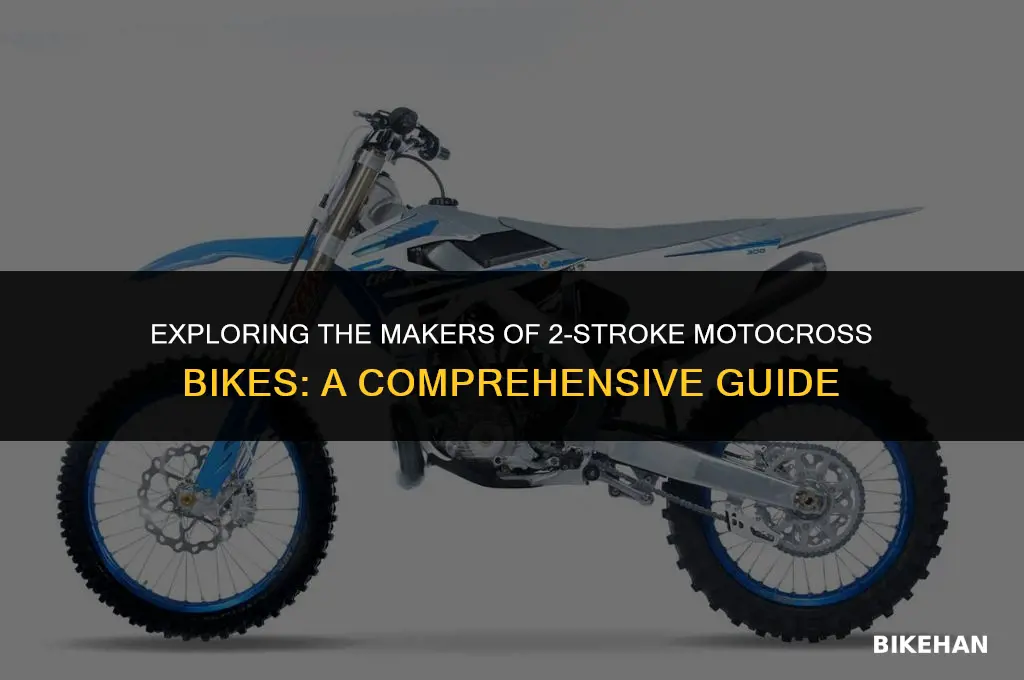
Several manufacturers produce two-stroke motocross bikes, catering to enthusiasts who prefer the simplicity and power-to-weight ratio of these engines. Notable brands include KTM, known for their competitive racing bikes; Husqvarna, which offers a range of two-stroke models; and Yamaha, with their YZ series being popular among riders. Other manufacturers like Suzuki, Kawasaki, and Honda also have two-stroke motocross bikes in their lineups, although they have shifted more towards four-stroke engines in recent years.
Explore related products


What You'll Learn
- Manufacturers Overview: Major companies producing two-stroke motocross bikes, including KTM, Husqvarna, and Yamaha
- Engine Technology: Innovations and advancements in two-stroke engine design for motocross bikes
- Popular Models: Best-selling two-stroke motocross bike models and their key features
- Racing Performance: How two-stroke motocross bikes perform in competitive racing scenarios
- Maintenance Tips: Essential advice for maintaining and optimizing two-stroke motocross bikes

Manufacturers Overview: Major companies producing two-stroke motocross bikes, including KTM, Husqvarna, and Yamaha
KTM, Husqvarna, and Yamaha are three of the most prominent manufacturers of two-stroke motocross bikes, each with a rich history and a strong reputation in the industry. KTM, an Austrian company, has been at the forefront of motocross innovation since its inception in 1953. Known for their high-performance bikes, KTM has consistently pushed the boundaries of what is possible in two-stroke engine technology. Their commitment to research and development has resulted in numerous championships and a loyal following among motocross enthusiasts.
Husqvarna, a Swedish brand with roots dating back to 1903, has also made significant contributions to the world of motocross. Acquired by KTM in 2013, Husqvarna has continued to operate as a distinct entity, offering a range of two-stroke bikes that are both competitive and accessible. The brand's focus on lightweight construction and user-friendly design has made it a popular choice for riders of all skill levels.
Yamaha, a Japanese multinational corporation, has been a major player in the motocross scene since the 1970s. With a diverse lineup of two-stroke bikes, Yamaha has catered to a wide range of riders, from amateur racers to professional athletes. The company's emphasis on reliability and durability has earned it a reputation for producing bikes that can withstand the rigors of motocross racing.
In recent years, the two-stroke motocross bike market has seen a resurgence in popularity, driven in part by the efforts of these major manufacturers. KTM, Husqvarna, and Yamaha have all invested heavily in developing new technologies and improving existing models, resulting in a new generation of bikes that are more powerful, efficient, and environmentally friendly than ever before. As the sport of motocross continues to evolve, these companies are well-positioned to lead the way, offering riders the tools they need to push their limits and achieve their goals.
Pedaling Back in Time: Huffy's Western Flyer Bikes Era
You may want to see also
Explore related products


Engine Technology: Innovations and advancements in two-stroke engine design for motocross bikes
Recent advancements in two-stroke engine technology have significantly impacted the motocross industry, offering riders more powerful, efficient, and environmentally friendly options. One notable innovation is the development of fuel injection systems in two-stroke engines, which has improved fuel efficiency and reduced emissions. This technology allows for more precise control over the fuel-air mixture, resulting in better performance and reliability.
Another key advancement is the use of lightweight materials, such as aluminum and carbon fiber, in engine construction. These materials reduce the overall weight of the bike, enhancing maneuverability and speed. Additionally, advancements in exhaust system design have led to improved power output and reduced noise levels, making two-stroke motocross bikes more competitive and rider-friendly.
Manufacturers like KTM, Husqvarna, and Yamaha have been at the forefront of these innovations, continually pushing the boundaries of two-stroke engine design. KTM, for example, has developed a revolutionary two-stroke engine with a fuel injection system that rivals the performance of four-stroke engines. Husqvarna has focused on creating lightweight and compact engines that provide exceptional power-to-weight ratios. Yamaha has also made significant strides in two-stroke technology, incorporating advanced features like liquid cooling and electronic ignition systems.
These advancements have not only improved the performance of two-stroke motocross bikes but have also made them more accessible to a wider range of riders. As technology continues to evolve, it is likely that two-stroke engines will remain a popular choice for motocross enthusiasts, offering a unique blend of power, agility, and simplicity.
Exploring the Makers of Adventure Folding Bikes: A Comprehensive Guide
You may want to see also
Explore related products


Popular Models: Best-selling two-stroke motocross bike models and their key features
The Yamaha YZ250 is another iconic two-stroke motocross bike that has garnered a loyal following over the years. Known for its lightweight frame and powerful engine, the YZ250 has been a staple in Yamaha's lineup since the 1970s. Its air-cooled, 249cc engine delivers a strong power-to-weight ratio, making it a favorite among riders who prefer the agility and responsiveness of two-strokes. The bike's aluminum frame and advanced suspension system provide excellent handling and control on the track.
The KTM 250SX is a modern interpretation of the classic two-stroke motocross bike, combining KTM's renowned engineering with contemporary design. Its 248cc engine features advanced fuel injection technology, providing a smooth and consistent power delivery. The bike's lightweight composite frame and high-performance suspension system make it a formidable competitor on the track. KTM's attention to detail is evident in the 250SX's ergonomics and rider-focused design, making it a popular choice among both amateur and professional riders.
The Suzuki RM-Z250 is a two-stroke motocross bike that has been a part of Suzuki's lineup since the early 2000s. Its 249cc engine is known for its strong mid-range power and smooth throttle response. The RM-Z250 features a lightweight aluminum frame and advanced suspension system, providing excellent handling and control on a variety of terrains. Suzuki's commitment to innovation is evident in the RM-Z250's design, making it a popular choice among riders who appreciate both performance and reliability.
The Honda CR250R is a legendary two-stroke motocross bike that has a storied history in the sport. Its 249cc engine is known for its explosive power and responsive throttle, making it a favorite among riders who prefer the raw energy of two-strokes. The CR250R's lightweight frame and advanced suspension system provide excellent handling and control on the track. Honda's reputation for quality and performance is evident in the CR250R's design, making it a sought-after model among motocross enthusiasts.
Crafting the Future: Innovators Behind the Mek Bike Revolution
You may want to see also
Explore related products


Racing Performance: How two-stroke motocross bikes perform in competitive racing scenarios
In competitive racing scenarios, two-stroke motocross bikes are known for their exceptional power-to-weight ratio, which allows riders to achieve impressive acceleration and top speeds. This is particularly advantageous in short, intense races where quick starts and rapid overtaking are crucial. The lightweight design of two-stroke bikes also contributes to better handling and maneuverability, enabling riders to navigate tight turns and rough terrain with greater ease.
However, the performance of two-stroke motocross bikes in racing is not without its challenges. One significant drawback is their limited fuel capacity, which can result in shorter race times and more frequent pit stops. Additionally, two-stroke engines are less fuel-efficient than their four-stroke counterparts, leading to higher fuel consumption and increased costs over the course of a racing season.
Despite these limitations, two-stroke motocross bikes remain popular among competitive riders due to their unique performance characteristics. Manufacturers such as KTM, Husqvarna, and Yamaha continue to produce high-performance two-stroke models specifically designed for racing. These bikes often feature advanced suspension systems, lightweight frames, and powerful engines to maximize their competitive edge.
In recent years, there has been a resurgence of interest in two-stroke motocross bikes, driven in part by the success of professional riders who have chosen to compete on these machines. This has led to increased investment in two-stroke technology and a renewed focus on improving their performance in racing scenarios. As a result, modern two-stroke motocross bikes are more competitive than ever, offering riders a unique combination of power, agility, and excitement on the track.
Exploring Schwinn's Taiwanese Manufacturing Era: A Historical Overview
You may want to see also
Explore related products


Maintenance Tips: Essential advice for maintaining and optimizing two-stroke motocross bikes
Regular maintenance is crucial for the optimal performance and longevity of two-stroke motocross bikes. One key aspect often overlooked is the importance of using high-quality, synthetic lubricants for both the engine and transmission. These lubricants provide superior protection against wear and corrosion, ensuring smoother operation and reducing the risk of costly repairs down the line.
Another critical maintenance tip is to frequently inspect and clean the air filter. A clogged air filter can significantly impede engine performance, leading to reduced power output and poor fuel efficiency. By regularly cleaning or replacing the air filter, riders can ensure that their two-stroke motocross bikes continue to run at peak performance levels.
In addition to these routine maintenance tasks, it's essential to pay close attention to the bike's cooling system. Two-stroke engines generate a considerable amount of heat, and an inefficient cooling system can lead to overheating and engine damage. Riders should regularly check the coolant levels, inspect the radiator for any signs of damage or blockage, and ensure that the cooling fins are clean and free of debris.
When it comes to optimizing two-stroke motocross bikes, one often-overlooked area is the carburetor. A well-tuned carburetor can significantly improve engine performance, providing better throttle response and increased power output. Riders should consult their bike's manual for specific tuning recommendations and consider investing in a high-quality aftermarket carburetor for enhanced performance.
Finally, it's crucial to address any issues with the bike's suspension system promptly. A poorly maintained suspension can lead to reduced handling performance and increased rider fatigue. Regularly inspecting and servicing the suspension components, including checking for leaks and ensuring proper preload and damping settings, can help riders maintain optimal control and comfort during their rides.
By following these essential maintenance and optimization tips, riders can ensure that their two-stroke motocross bikes continue to perform at their best, providing an exhilarating and reliable riding experience.
BMW's Next Adventure: When Will They Enter the Touring Bike Market?
You may want to see also
Frequently asked questions
The main manufacturers of 2-stroke motocross bikes include KTM, Husqvarna, Yamaha, and Suzuki. These companies are well-known for producing high-performance off-road motorcycles.
Yes, 2-stroke motocross bikes remain popular in the sport due to their lightweight design, simplicity, and the distinct riding experience they offer. Many riders prefer the handling and power delivery of 2-stroke engines, especially in certain racing conditions.
2-stroke motocross bikes offer several advantages over 4-stroke bikes, including lower weight, which makes them easier to maneuver and control. They also have a simpler engine design, which can result in lower maintenance costs. Additionally, 2-stroke engines typically provide a more responsive power delivery, which can be beneficial in off-road racing scenarios.